Here I am
to dash off a quick sketch of the introduction to Hughes Old's book "Worship Reformed according to Scripture". First of all, this is a new book, written in 2002. So, presumably, the author is in tune with the current state of the church overall, to some degree.
Old makes the claim that we worship God primarily for two reasons. First, we were created for this reason. In fact all creation exists for this reason. It is with this in mind that we strive to glorify God when we worship Him. The second reason that we worship Him is that we are commanded to do so. Old rightly sees the first four of the ten commandments specifically pointing to worship. (He holds the reformed position, that Deut 5:7 is the first commandment and 5:8 is the second, whereas Lutherans and the Roman Catholic church holds those two verses as one commandment. They arrive at ten by splitting the 10th commandment into two.)
The first commandment is really what worship is all about. Loving God supremely. (Piece of cake, right?). The second addresses specifics about what goes in and on in worship. Desire for fine expressions of art, entertainment or excitement in worship are misdirected and a violation of the second commandment. The third commandment, in adjuring us not to use God's name in vain, says we must worship honestly and sincerely (here is worship in spirit and truth). The fourth commandment ties the first three to real life; that this worship is to take place in our real lives on a real day, namely the sabbath.
Old then lays out three simple and clear principles of reformed worship. They are:
- It is according to Scripture
- It is done in the name of Christ. Baptism, gathering, prayer, preaching, teaching, alms giving and more are all done in the name of Christ.
- It is the work of the Holy Spirit. Praying, singing, preaching and testifying are all done in the Spirit. Any time the Holy Spirit is involved, holiness on the part of the covenant community is also an issue. Unification into one body, sanctification, edification, transformation and salvation are all the products of worship.
Up next, Baptism.
Sunday, September 18, 2005

Saturday, September 17, 2005
It's saturday night
again. Time for my extra income drive. Last week set me back $100. (But I did get 1 of 3 right). Not to worry. A couple of good weeks and I am way ahead.
So, here are my bets:
Patriots to win and cover 3 pts. on the road against Carolina.
Miami on the road to come within 6 pts of the Jets.
Jacksonville on the road to come within 9 pts of the Colts.
again. Time for my extra income drive. Last week set me back $100. (But I did get 1 of 3 right). Not to worry. A couple of good weeks and I am way ahead.
So, here are my bets:
Patriots to win and cover 3 pts. on the road against Carolina.
Miami on the road to come within 6 pts of the Jets.
Jacksonville on the road to come within 9 pts of the Colts.
Friday, September 16, 2005
Get your Bible
out. I have class on Fridays and this quick article addresses the mind blowing gem I heard today. It's periferally about a statement I made to Deb 18 months ago when, holding up my leather bound New King James (Nelson Pub.), I told her that the thing I was holding wasn't the Bible. And it wasn't infallible, or inerrant or any of those nice things we have always been told it was. She put up quite a fight.
My argument was that the true scripture can only be found in what manuscripts we have available. That is, in the case of the N.T., only the original Greek is infallible. This is true regardless of the fact that many of the manuscripts don't agree and the originals can't be found. It is our job to sort them out and arrive at which parts of which manuscripts constitute the truth. The truth is in there nevertheless.
But the leather bound thing in my hand is not inerrant simply because it is an English translation performed by imperfect humans.
I am here, tonight, to show you a beautiful example of this.
Without presenting any context, consider Romans 10:13-14, but specifically, verse 14.
Rom 10:13 - For "everyone who calls on the name of the Lord will be saved."
What follows here is a handful of translations of verse 14.
ASV How then shall they call on him in whom they have not believed? and how shall they believe in him whom they have not heard? and how shall they hear without a preacher?
ESV But how are they to call on him in whom they have not believed? And how are they to believe in him of whom they have never heard? And how are they to hear without someone preaching?
KJV How then shall they call on him in whom they have not believed?? and how shall they believe in him of whom they have not heard? and how shall they hear without a preacher?
NAS How then shall they call upon Him in whom they have not believed? And how shall they believe in Him whom they have not heard? And how shall they hear without a preacher?
NIV How, then, can they call on the one they have not believed in? And how can they believe in the one of whom they have not heard? And how can they hear without someone preaching to them?
RSV But how are men to call upon him in whom they have not believed? And how are they to believe in him of whom they have never heard? And how are they to hear without a preacher?
Read those six versions of verse 14 carefully.
Two of those six is significantly different from all the others. The difference is enormous. If you haven't spotted it, it is probably because textually it is minute and you may be looking for something monumental. The version that is substantially different in meaning and impact is the American Standard Version, ASV and its updated equivalent, NAS. So, armed with this info, reread it, along with any other one, and let how the NAS translators have translated Paul sink in. "How can they believe in Jesus, whom they have not heard." The other four have it "of whom (or in whom) they have not heard."
At this point, it is fair to address whether or not the ASV/NAS translators got it right. The answer, of course is, yes. The others got it wrong, with the resulting impoverishment of the church.
You may not think that is much of a difference, but in effect, he is saying that you or I have to actually hear Jesus speak to believe in him. "How is it possible to believe in Jesus unless you actually have heard him speak?" is the question. And then Paul goes on to answer the question with another question which in essence says, "By hearing a preacher, you are hearing Jesus speak."
This verse, by the way, is the backing for the often heard claim made in Reformed churches, that in the sermon, you hear "God speak to us through his Word"even though preachers are mere men, and not remotely in the same category as Apostles.
The analysis of the Greek that backs up the NAS translation is simply that the "whom" in this text is a genitive pronoun that functions as a direct object. This is because the verb "hear" is unique (along with some others) in that it takes a genitive direct object when what is heard is a person, and an accusative direct object when what is heard is a thing. Therefore, there is no warrant for translating it "of whom" or "in whom".
So, this example serves to demonstrate that your leather bound KJV is not the Bible, although it is close enough for jazz and government work.
out. I have class on Fridays and this quick article addresses the mind blowing gem I heard today. It's periferally about a statement I made to Deb 18 months ago when, holding up my leather bound New King James (Nelson Pub.), I told her that the thing I was holding wasn't the Bible. And it wasn't infallible, or inerrant or any of those nice things we have always been told it was. She put up quite a fight.
My argument was that the true scripture can only be found in what manuscripts we have available. That is, in the case of the N.T., only the original Greek is infallible. This is true regardless of the fact that many of the manuscripts don't agree and the originals can't be found. It is our job to sort them out and arrive at which parts of which manuscripts constitute the truth. The truth is in there nevertheless.
But the leather bound thing in my hand is not inerrant simply because it is an English translation performed by imperfect humans.
I am here, tonight, to show you a beautiful example of this.
Without presenting any context, consider Romans 10:13-14, but specifically, verse 14.
Rom 10:13 - For "everyone who calls on the name of the Lord will be saved."
What follows here is a handful of translations of verse 14.
ASV How then shall they call on him in whom they have not believed? and how shall they believe in him whom they have not heard? and how shall they hear without a preacher?
ESV But how are they to call on him in whom they have not believed? And how are they to believe in him of whom they have never heard? And how are they to hear without someone preaching?
KJV How then shall they call on him in whom they have not believed?? and how shall they believe in him of whom they have not heard? and how shall they hear without a preacher?
NAS How then shall they call upon Him in whom they have not believed? And how shall they believe in Him whom they have not heard? And how shall they hear without a preacher?
NIV How, then, can they call on the one they have not believed in? And how can they believe in the one of whom they have not heard? And how can they hear without someone preaching to them?
RSV But how are men to call upon him in whom they have not believed? And how are they to believe in him of whom they have never heard? And how are they to hear without a preacher?
Read those six versions of verse 14 carefully.
Two of those six is significantly different from all the others. The difference is enormous. If you haven't spotted it, it is probably because textually it is minute and you may be looking for something monumental. The version that is substantially different in meaning and impact is the American Standard Version, ASV and its updated equivalent, NAS. So, armed with this info, reread it, along with any other one, and let how the NAS translators have translated Paul sink in. "How can they believe in Jesus, whom they have not heard." The other four have it "of whom (or in whom) they have not heard."
At this point, it is fair to address whether or not the ASV/NAS translators got it right. The answer, of course is, yes. The others got it wrong, with the resulting impoverishment of the church.
You may not think that is much of a difference, but in effect, he is saying that you or I have to actually hear Jesus speak to believe in him. "How is it possible to believe in Jesus unless you actually have heard him speak?" is the question. And then Paul goes on to answer the question with another question which in essence says, "By hearing a preacher, you are hearing Jesus speak."
This verse, by the way, is the backing for the often heard claim made in Reformed churches, that in the sermon, you hear "God speak to us through his Word"even though preachers are mere men, and not remotely in the same category as Apostles.
The analysis of the Greek that backs up the NAS translation is simply that the "whom" in this text is a genitive pronoun that functions as a direct object. This is because the verb "hear" is unique (along with some others) in that it takes a genitive direct object when what is heard is a person, and an accusative direct object when what is heard is a thing. Therefore, there is no warrant for translating it "of whom" or "in whom".
So, this example serves to demonstrate that your leather bound KJV is not the Bible, although it is close enough for jazz and government work.
Thursday, September 15, 2005
Before I start with
brief summaries of the chapters on reformed worship, I must get on with a sanctification view. If I delay it much longer, the mo-jo will die out completely and I will be deemed a total failure. So, without further adieu, I present sanctification view number 3. Please bear with me in this review since bulletizing hasn't worked very well. I expect only the most keen readers (meaning those that actually give a fig) to read this. Blue, bold text is the Cliff notes version of this report. By all means, read at least that much. Also, due to lack of time, the verses listed here are not linked, sorry.
1) Normal christians are Christ like. By that is meant the normal Christian is characterized by loving responses to ingratitude and indifference, even hostility, and is filled with joy in the midst of unhappy circumstances and peace when everything is going wrong. The normal Christian overcomes in the battle with temptation, consistently obeys the laws of God, and grows in self control, contentment, humility and courage. Thought processes are so under the control of the Holy Spirit and instructed by Scripture that the normal Christian authentically reflects the attitudes and behavior of Jesus Christ. God has first place in his life, and the welfare of others takes precedence over personal desires. The normal Christian has power not only for godly living but for effective service in the church. Above all, he or she has the joy of constant companionship with the Lord.
2) However, the average christian is decent enough but there is nothing supernatural about him. When confronted by temptation he succumbs. He is characterized by self-interest.
Ed. note: If you are not in bullet one, but more like bullet two, then we can get you in 1) if you just follow the following easy steps.
3) Immediate abandonment of every known sin, doubt, indulgence, or conscious hindrance to holy living. Rom. 6:12-14; 8:12-14; 14:21-2 and Heb. 12:1-2.
4) Surrender of the will and the whole being to Jesus Christ as not only savior, but master and Lord, in loving and complete obedience. Rom 10:9, 1 Cor 12:3.
5) Appropriation by faith of God’s promise and power for holy and righteous living. Rom. 4:20-25; 6:2, 2 Peter 1:4 and Heb 8:10
6) voluntary renunciation and mortification of the self-life, which centers in self-indulgence and self-dependence, that God may be all in all. Gal.2:19-20; 4:24,25; Col 3:5; 2 Cor 5:15.
7) Enduement with power and infilling with the Spirit. Lk. 24:49, Acts 1:8; Eph 5:18
This view holds a strong view of sin, however. Sin is an offense to God, a ruling principle in man. Man is totally depraved. The power of sin is so intense that it is never broken. Sin is a spiritual disease. Sin is an indwelling tendency that remains throughout life. This view explicitly disavows eradication of the sin nature. Its answer to this is its doctrine of counteraction. It is by the power of the Spirit that the power of sin is counteracted. The tendency to sin remains with the believer, but is the greater force of the spirit dispels this darkness of sin. If one walks in the Spirit the Spirit carries the burden of Sin. If one sins, the Spirit no longer counteracts the tendency to sin and the believer is caught in a spiral of sin. He has no more help in overcoming sin than the unbeliever.
brief summaries of the chapters on reformed worship, I must get on with a sanctification view. If I delay it much longer, the mo-jo will die out completely and I will be deemed a total failure. So, without further adieu, I present sanctification view number 3. Please bear with me in this review since bulletizing hasn't worked very well. I expect only the most keen readers (meaning those that actually give a fig) to read this. Blue, bold text is the Cliff notes version of this report. By all means, read at least that much. Also, due to lack of time, the verses listed here are not linked, sorry.
1) Normal christians are Christ like. By that is meant the normal Christian is characterized by loving responses to ingratitude and indifference, even hostility, and is filled with joy in the midst of unhappy circumstances and peace when everything is going wrong. The normal Christian overcomes in the battle with temptation, consistently obeys the laws of God, and grows in self control, contentment, humility and courage. Thought processes are so under the control of the Holy Spirit and instructed by Scripture that the normal Christian authentically reflects the attitudes and behavior of Jesus Christ. God has first place in his life, and the welfare of others takes precedence over personal desires. The normal Christian has power not only for godly living but for effective service in the church. Above all, he or she has the joy of constant companionship with the Lord.
2) However, the average christian is decent enough but there is nothing supernatural about him. When confronted by temptation he succumbs. He is characterized by self-interest.
Ed. note: If you are not in bullet one, but more like bullet two, then we can get you in 1) if you just follow the following easy steps.
3) Immediate abandonment of every known sin, doubt, indulgence, or conscious hindrance to holy living. Rom. 6:12-14; 8:12-14; 14:21-2 and Heb. 12:1-2.
4) Surrender of the will and the whole being to Jesus Christ as not only savior, but master and Lord, in loving and complete obedience. Rom 10:9, 1 Cor 12:3.
5) Appropriation by faith of God’s promise and power for holy and righteous living. Rom. 4:20-25; 6:2, 2 Peter 1:4 and Heb 8:10
6) voluntary renunciation and mortification of the self-life, which centers in self-indulgence and self-dependence, that God may be all in all. Gal.2:19-20; 4:24,25; Col 3:5; 2 Cor 5:15.
7) Enduement with power and infilling with the Spirit. Lk. 24:49, Acts 1:8; Eph 5:18
This view holds a strong view of sin, however. Sin is an offense to God, a ruling principle in man. Man is totally depraved. The power of sin is so intense that it is never broken. Sin is a spiritual disease. Sin is an indwelling tendency that remains throughout life. This view explicitly disavows eradication of the sin nature. Its answer to this is its doctrine of counteraction. It is by the power of the Spirit that the power of sin is counteracted. The tendency to sin remains with the believer, but is the greater force of the spirit dispels this darkness of sin. If one walks in the Spirit the Spirit carries the burden of Sin. If one sins, the Spirit no longer counteracts the tendency to sin and the believer is caught in a spiral of sin. He has no more help in overcoming sin than the unbeliever.
Four clear cut phases of sanctification in this view are:
a. positional sanctification - 1 Cor 1:30.
b. day to day transformation which begins at regeneration and continues throughout this life.
c. By a deliberate and decisive act of faith, one may step into his rightful heritage of sustained victory over known sin; constant defeat, grinding bondage and restless worry can be exchanged for a life of ‘perfect peace’. The Bible shows that in Christ there is liberty and rest. This is to be obtained not by a lifetime of struggle, but by surrender to the Spirit of God.
At the time of the above crisis comes a realization that Christ is our Sanctification. (1 Cor 1:30) Ed. note: same verse here as in the text for positional sanctification. He must be accepted as such by an act of faith.
Christ must be definitely accepted as our sanctification; if we wish to make any progress in holiness, we have to give up belief in the value of self-effort in holiness. The gift of holiness must be worked out in our daily life, but we work from holiness, not to holiness. To become holy we must possess the holy one. It must be Christ in us.
4.Transformation into the likeness of Christ after death.
There are two more key areas that this view focuses on.
The first is an act of consecration. By this is meant full surrender. As a result of this surrender all areas of life are changed. Through this experience the power of God will begin to flow in the life of the believer. This full surrender is necessary because the self is totally sinful and worthless. We must hate and utterly lose our own life. So long as I myself am still something, Jesus cannot be everything. When your life is cast out, God will fill you; your life must be expelled.
This view has an understanding of human nature in which the regenerate man is dualistic. There exists the old nature which is totally sinful and is to be identified with the self. Along side the Old nature there dwells the new nature which is the part of the individual which has communion with God.
The final key piece to this view of sanctification is the filling of the Holy Spirit. This emphasis flows from consecration. The understanding of the filing of the spirit is rooted in Ephesians 5:18 as seen through the exegetical lens of human sinfulness and absolute surrender. This is what or how the filling of the Holy Spirit works: We try to imitate Christ, struggling after perfect obedience. but at every turn we fail. Finally we give up. Then God gives us the vision of the indwelling Christ. He will unite himself to us, blending his life with ours. Christ will think through our minds. Christ will keep the law within us! He will destroy the dominion of sin and dethrone self in us.
My comments: This is a formulaic view. The crisis step (c above) is a second and necessary step that occurs post conversion. The dualistic view of the human soul is a distinctive of this view of sanctification.
Wednesday, September 14, 2005
I have started reading
the book on reformed worship by Hughes Old. These are the chapter headings: 1) Basic principles 2) Baptism 3) The Lord's Day 4) The Ministry of Praise 5) The Ministry of the Word 6) The Ministry of Prayer 7) The Lord's Supper 8) Daily Prayer 9) Alms 10) Tradition and Practice. This list highlights the major elements. Ancillary details such as the 'call to worship' the doxology and the benediction aren't, I am guessing here, even mentioned in the book.
For twenty plus years (since '79) having heard the term "worship leader" refer to the song leader, this list of what worship entails is hard to get used to. In fact, prior to 1979, there was no song leader in my Christian experience either. Even in public 'hymn sings' the only guy leading anything was Norbel Reems on the piano. That guy could play a mean evangelical piano.
So, then in 1979, when I stepped (dived) into evangelicalism, I thought elevating the song leader's title to worship leader was a good thing. The truth is that we knew worship was more than just singing. We also held that worship was more than praising. But in general praising was the real deal - effectively treated as a sacrament and your fervor in its participation was a sign of your spiritual condition. We were taught that there were 9 ways to express praise. E.g. standing, kneeling, clapping, singing, shouting, dancing, bowing, lifting hands and uh, uh, being forgetful.
This list has gone for quite a while without being taught - at least in my recollection, some readers here may correct me on that, since I have been out in left field for a few years. (I may be out of line, but encouraging congregational free form dancing is not on the church growth movement's list of 'ten things that will build your church really big, really fast').
But the idea that baptism of infants is a hugely integral part of worship is plainly foreign to my thinking for the last 25 years. I am excited to begin reading this book. I anticipate a liberating change in my viewpoint toward corporate worship.
I plan to, as I finish each chapter, give you a thumbnail sketch of the salient points. (Be thankful that I don't plan to do this with each book in my class).
the book on reformed worship by Hughes Old. These are the chapter headings: 1) Basic principles 2) Baptism 3) The Lord's Day 4) The Ministry of Praise 5) The Ministry of the Word 6) The Ministry of Prayer 7) The Lord's Supper 8) Daily Prayer 9) Alms 10) Tradition and Practice. This list highlights the major elements. Ancillary details such as the 'call to worship' the doxology and the benediction aren't, I am guessing here, even mentioned in the book.
For twenty plus years (since '79) having heard the term "worship leader" refer to the song leader, this list of what worship entails is hard to get used to. In fact, prior to 1979, there was no song leader in my Christian experience either. Even in public 'hymn sings' the only guy leading anything was Norbel Reems on the piano. That guy could play a mean evangelical piano.
So, then in 1979, when I stepped (dived) into evangelicalism, I thought elevating the song leader's title to worship leader was a good thing. The truth is that we knew worship was more than just singing. We also held that worship was more than praising. But in general praising was the real deal - effectively treated as a sacrament and your fervor in its participation was a sign of your spiritual condition. We were taught that there were 9 ways to express praise. E.g. standing, kneeling, clapping, singing, shouting, dancing, bowing, lifting hands and uh, uh, being forgetful.
This list has gone for quite a while without being taught - at least in my recollection, some readers here may correct me on that, since I have been out in left field for a few years. (I may be out of line, but encouraging congregational free form dancing is not on the church growth movement's list of 'ten things that will build your church really big, really fast').
But the idea that baptism of infants is a hugely integral part of worship is plainly foreign to my thinking for the last 25 years. I am excited to begin reading this book. I anticipate a liberating change in my viewpoint toward corporate worship.
I plan to, as I finish each chapter, give you a thumbnail sketch of the salient points. (Be thankful that I don't plan to do this with each book in my class).
Tuesday, September 13, 2005

Monday, September 12, 2005
Earlier, I promised
to pass along stuff from the Ministry of the Word class, which has met twice now. The majority of the time spent in the class has focused on Col 1:24-2:7. This passage comprises a good description of what is involved in ministry of the word. Here is the passage:
Now I rejoice in my sufferings for your sake, and in my flesh I am filling up what is lacking in Christ's afflictions for the sake of his body, that is, the church, of which I became a minister according to the stewardship from God that was given to me for you, to make the word of God fully known, the mystery hidden for ages and generations but now revealed to his saints. To them God chose to make known how great among the Gentiles are the riches of the glory of this mystery, which is Christ in you, the hope of glory. Him we proclaim, warning everyone and teaching everyone with all wisdom, that we may present everyone mature in Christ. For this I toil, struggling with all his energy that he powerfully works within me. For I want you to know how great a struggle I have for you and for those at Laodicea and for all who have not seen me face to face, that their hearts may be encouraged, being knit together in love, to reach all the riches of full assurance of understanding and the knowledge of God's mystery, which is Christ, in whom are hidden all the treasures of wisdom and knowledge. I say this in order that no one may delude you with plausible arguments. For though I am absent in body, yet I am with you in spirit, rejoicing to see your good order and the firmness of your faith in Christ. Therefore, as you received Christ Jesus the Lord, so walk in him, rooted and built up in him and established in the faith, just as you were taught, abounding in thanksgiving.
Dr. Johnson spent several hours of class lecture time elaborating seven themes contained in this passage.
They were:
Content - The content of Paul's message is Christ. This comes through pretty loud and clear in this passage.
Listeners - Paul's audience is the gentiles.
Purpose - Paul's purpose in ministry is 'that we may present everyone mature in Christ'. The word 'mature' here is teleios which is also translated elsewhere as perfect(morally), complete.
Method - Paul's primary method is to teach and to warn (admonish).
Price - The price Paul pays for his ministry is toil and struggle, (and elsewhere, suffering from opposition, as is well known and struggling with his own sin).
Resource - Jesus e.g. "struggling with all his energy that he powerfully works within me".
Master - Paul viewed the gospel, the church, and God as that for which he was a slave.
A personal note on the class is that the general tone is geared for those who are called to pastor a group of believers. That leaves me out. So it is a little awkward at times. Although it was good to be back in class. I had a revelation of sorts; okay, not a revelation, more like a thought or a resolve. I see that there is no compelling thing behind me finishing this coursework. My attitude is that I shall show up for one class at a time as long as the sem. lets me and as long as my job will allow it. What comes of it all is TBD.
Coming, maybe not so soon but probably by the end of the week is a sanctification view. The problem is to sort out the distinctives of each view where there is a fair amount of overlap. The last one presented was easy because it was so distinctly unique. But the one I am working on now is tough.
to pass along stuff from the Ministry of the Word class, which has met twice now. The majority of the time spent in the class has focused on Col 1:24-2:7. This passage comprises a good description of what is involved in ministry of the word. Here is the passage:
Now I rejoice in my sufferings for your sake, and in my flesh I am filling up what is lacking in Christ's afflictions for the sake of his body, that is, the church, of which I became a minister according to the stewardship from God that was given to me for you, to make the word of God fully known, the mystery hidden for ages and generations but now revealed to his saints. To them God chose to make known how great among the Gentiles are the riches of the glory of this mystery, which is Christ in you, the hope of glory. Him we proclaim, warning everyone and teaching everyone with all wisdom, that we may present everyone mature in Christ. For this I toil, struggling with all his energy that he powerfully works within me. For I want you to know how great a struggle I have for you and for those at Laodicea and for all who have not seen me face to face, that their hearts may be encouraged, being knit together in love, to reach all the riches of full assurance of understanding and the knowledge of God's mystery, which is Christ, in whom are hidden all the treasures of wisdom and knowledge. I say this in order that no one may delude you with plausible arguments. For though I am absent in body, yet I am with you in spirit, rejoicing to see your good order and the firmness of your faith in Christ. Therefore, as you received Christ Jesus the Lord, so walk in him, rooted and built up in him and established in the faith, just as you were taught, abounding in thanksgiving.
Dr. Johnson spent several hours of class lecture time elaborating seven themes contained in this passage.
They were:
Content - The content of Paul's message is Christ. This comes through pretty loud and clear in this passage.
Listeners - Paul's audience is the gentiles.
Purpose - Paul's purpose in ministry is 'that we may present everyone mature in Christ'. The word 'mature' here is teleios which is also translated elsewhere as perfect(morally), complete.
Method - Paul's primary method is to teach and to warn (admonish).
Price - The price Paul pays for his ministry is toil and struggle, (and elsewhere, suffering from opposition, as is well known and struggling with his own sin).
Resource - Jesus e.g. "struggling with all his energy that he powerfully works within me".
Master - Paul viewed the gospel, the church, and God as that for which he was a slave.
A personal note on the class is that the general tone is geared for those who are called to pastor a group of believers. That leaves me out. So it is a little awkward at times. Although it was good to be back in class. I had a revelation of sorts; okay, not a revelation, more like a thought or a resolve. I see that there is no compelling thing behind me finishing this coursework. My attitude is that I shall show up for one class at a time as long as the sem. lets me and as long as my job will allow it. What comes of it all is TBD.
Coming, maybe not so soon but probably by the end of the week is a sanctification view. The problem is to sort out the distinctives of each view where there is a fair amount of overlap. The last one presented was easy because it was so distinctly unique. But the one I am working on now is tough.
Saturday, September 10, 2005
If I put
$100 on a three team parlay against the Las Vegas NFL spreads this weekend, and win, I will make $600 (plus get my $100 back). This kind of money is too good to pass up. So, in order to raise the $3000 I need by Nov. 1 for my gum surgery, my hundred bucks this week, would go on:
St. Louis Rams to beat the Niners by more than 5.5 points,
Denver Broncos to beat the Dolphins by more than 4 points, and
Da Bears to cover the Skins, favorites by 5.5
$100 on a three team parlay against the Las Vegas NFL spreads this weekend, and win, I will make $600 (plus get my $100 back). This kind of money is too good to pass up. So, in order to raise the $3000 I need by Nov. 1 for my gum surgery, my hundred bucks this week, would go on:
St. Louis Rams to beat the Niners by more than 5.5 points,
Denver Broncos to beat the Dolphins by more than 4 points, and
Da Bears to cover the Skins, favorites by 5.5
I can't seem to get any of
the regular commenters to bite on the real question. More on that in a second.
If you are a Jew, then the correct answer is d, Jesus did not pay the price for any sins of anyone. In fact, the whole enterprise of Christ as some kind of a God is entirely discredited by the fact that he was cursed - i.e. hung on a tree outside the camp.
If you are an Arminian, then the correct answer is d, provisionally. That is, on the cross he did not pay the price for my sin but must wait until I play my part in the transaction. Until then, he only made it possible for my sins to be paid for. This view is provocative in that it allows for a scenario that no-one might have been atoned for. Since God doesn't force anyone to believe, God gambled that some would accept the free offer of salvation. Now we have God as the dependent variable in the equation.
If you are a universalist, then the correct answer is a. He paid the price for all sins of all men. John 12:32 "and I, if I be lifted up from the earth, will draw all men to Myself" seems to suggest that very thing. What makes this game fun to play is that those who believe in God's sovereignty WRT salvation have trouble with the passage in 1 Tim 2:1-4 "First of all, then, I urge that supplications, prayers, intercessions, and thanksgivings be made for all people, for kings and all who are in high positions, that we may lead a peaceful and quiet life, godly and dignified in every way. This is good, and it is pleasing in the sight of God our Savior, who desires all people to be saved and to come to the knowledge of the truth." They dodge what appears in this verse to be a defeater of particular or limited atonement (i.e. all people) by saying that this refers to all sorts of people, not just the Jews. That is, Jesus came as not just a Jewish messiah, but the savior of the whole world. Arminians don't want any of that logic. The fun part is that it must be sorely tempting for the Arminian to defeat the universalist argument in John 12:32 by playing their own "all sorts of people" card. But they can't.
So was Stalin drawn to Jesus? Pol Pot? McVeigh? (We know he used to be an altar boy in the RC). How about Charles Manson, Michael Moore, Sean Penn?
Maybe the way to put the universalists to bed, esp. WRT John 12:32 is by the "draw" cop out. Draw merely means "woo". As in "you can woo a horse to water but you can't make 'em drink". In other words, Jesus does in fact in some way woo everybody, just as the verse says. The problem is that draw doesn't mean woo. It means "pull by force", or "drag" as in Acts 21:30 "Then all the city was stirred up, and the people ran together. They seized Paul and dragged him out of the temple, and at once the gates were shut" or as in James 2:6 "But you have dishonored the poor man. Are not the rich the ones who oppress you, and the ones who drag you into court?" Same Greek word here for drag as draw in John 12:32. (A way out of the conundrum caused by this verse is actually very simple. Is it not plausible that Jesus will drag some to belief and drag some to judgment? A solution obviously in line with choosing b.)
What about c, Christ paid for some of the sins of all men? This doesn't work at all. Unless you are able to envision a heaven with nobody in it. All your sin must be atoned for.
One more scenario. And it causes problems. How about b but where all of the sins of some men includes their sin of unbelief, or even of rejection of Christ. That certainly would be a sin. But b says that this sin is forgiven, atoned for. (Isn't this how far you have to go to hold to the belief in unconditional election? I guess it must bring irresistible grace into play!)
What starts out as a simple puzzle can disintegrate into absurdity. But the puzzle seemed at the outset to be totally fair and rational. We certainly didn't overlook any significant permutations.
Is it possible that we shouldn't expect logic to work in some areas of religion? Is it possible that God doesn't want us to mess around with his business? I somehow doubt that is true at all. God has invited us to reason together with Him. So we have done a bit of it here.
the regular commenters to bite on the real question. More on that in a second.
If you are a Jew, then the correct answer is d, Jesus did not pay the price for any sins of anyone. In fact, the whole enterprise of Christ as some kind of a God is entirely discredited by the fact that he was cursed - i.e. hung on a tree outside the camp.
If you are an Arminian, then the correct answer is d, provisionally. That is, on the cross he did not pay the price for my sin but must wait until I play my part in the transaction. Until then, he only made it possible for my sins to be paid for. This view is provocative in that it allows for a scenario that no-one might have been atoned for. Since God doesn't force anyone to believe, God gambled that some would accept the free offer of salvation. Now we have God as the dependent variable in the equation.
If you are a universalist, then the correct answer is a. He paid the price for all sins of all men. John 12:32 "and I, if I be lifted up from the earth, will draw all men to Myself" seems to suggest that very thing. What makes this game fun to play is that those who believe in God's sovereignty WRT salvation have trouble with the passage in 1 Tim 2:1-4 "First of all, then, I urge that supplications, prayers, intercessions, and thanksgivings be made for all people, for kings and all who are in high positions, that we may lead a peaceful and quiet life, godly and dignified in every way. This is good, and it is pleasing in the sight of God our Savior, who desires all people to be saved and to come to the knowledge of the truth." They dodge what appears in this verse to be a defeater of particular or limited atonement (i.e. all people) by saying that this refers to all sorts of people, not just the Jews. That is, Jesus came as not just a Jewish messiah, but the savior of the whole world. Arminians don't want any of that logic. The fun part is that it must be sorely tempting for the Arminian to defeat the universalist argument in John 12:32 by playing their own "all sorts of people" card. But they can't.
So was Stalin drawn to Jesus? Pol Pot? McVeigh? (We know he used to be an altar boy in the RC). How about Charles Manson, Michael Moore, Sean Penn?
Maybe the way to put the universalists to bed, esp. WRT John 12:32 is by the "draw" cop out. Draw merely means "woo". As in "you can woo a horse to water but you can't make 'em drink". In other words, Jesus does in fact in some way woo everybody, just as the verse says. The problem is that draw doesn't mean woo. It means "pull by force", or "drag" as in Acts 21:30 "Then all the city was stirred up, and the people ran together. They seized Paul and dragged him out of the temple, and at once the gates were shut" or as in James 2:6 "But you have dishonored the poor man. Are not the rich the ones who oppress you, and the ones who drag you into court?" Same Greek word here for drag as draw in John 12:32. (A way out of the conundrum caused by this verse is actually very simple. Is it not plausible that Jesus will drag some to belief and drag some to judgment? A solution obviously in line with choosing b.)
What about c, Christ paid for some of the sins of all men? This doesn't work at all. Unless you are able to envision a heaven with nobody in it. All your sin must be atoned for.
One more scenario. And it causes problems. How about b but where all of the sins of some men includes their sin of unbelief, or even of rejection of Christ. That certainly would be a sin. But b says that this sin is forgiven, atoned for. (Isn't this how far you have to go to hold to the belief in unconditional election? I guess it must bring irresistible grace into play!)
What starts out as a simple puzzle can disintegrate into absurdity. But the puzzle seemed at the outset to be totally fair and rational. We certainly didn't overlook any significant permutations.
Is it possible that we shouldn't expect logic to work in some areas of religion? Is it possible that God doesn't want us to mess around with his business? I somehow doubt that is true at all. God has invited us to reason together with Him. So we have done a bit of it here.
Thursday, September 08, 2005
Quite a while ago,
I became seriously puzzled by the question of what Christ did for me personally, on the cross. I couldn't grasp the idea that he actually atoned for my sin then and there. If that was true, then my sins were forgiven then and there.
As I began to reflect deeper, I started to worry that the modern view might be seriously flawed. The modern view is that Christ didn't actually atone for anyone at that moment. His atonement only becomes effectual when a person does something, whether that be believing or accepting Jesus in their heart or being baptized or whatever. Then I stumbled upon this puzzle which directly addresses what, if anything, actually occured on the cross.
If you don't want to play, then maybe you can state reasons why this game is unfair, or rigged. Is there something about this puzzle that you don't think is square?
BTW, I added some material to the sanctification view of Sept. 7. Take a look.
I became seriously puzzled by the question of what Christ did for me personally, on the cross. I couldn't grasp the idea that he actually atoned for my sin then and there. If that was true, then my sins were forgiven then and there.
As I began to reflect deeper, I started to worry that the modern view might be seriously flawed. The modern view is that Christ didn't actually atone for anyone at that moment. His atonement only becomes effectual when a person does something, whether that be believing or accepting Jesus in their heart or being baptized or whatever. Then I stumbled upon this puzzle which directly addresses what, if anything, actually occured on the cross.
The Father imposed His wrath due unto, and the Son underwent punishment for, either:
- All the sins of all men.
- All the sins of some men, or
- Some of the sins of all men.
If you don't want to play, then maybe you can state reasons why this game is unfair, or rigged. Is there something about this puzzle that you don't think is square?
BTW, I added some material to the sanctification view of Sept. 7. Take a look.
Wednesday, September 07, 2005
I thought I would
knock out a quick sanctification view. I am coming back early with this report simply because this view is easy to relate to my readers. Note the added feature of the scripture verses now being links. Here goes:
Bullets:
o Sanctification = spiritual growth and development
o Emphasizes personal experience over theological precision
o Obedience to God is central concern
o Concerned with the radical transformation of persons through a gradual process requiring a step by step surrender and abandonment to God
o We may see God or be united with God, albeit fleetingly, while we are still earthbound
o The secret to achieving this is purity of heart
o Purity of heart is obtained by surrender, abandonment of self, submitting, yielding, humbling of self
o We cannot transform the impure into the pure. God alone can do that. If we surrender, love will come in and cleanse, purify and transform
o Three planks to achieve this purification
1) Suffering - suffering uproots ingratitude and opens us to God
2) Love - God loves you, love God back.
3) Prayer - which itself has four steps
a Use of the cognitive faculties i.e. your mind to know God - including study of scripture
b Meditation by which your imagination is used to acquire the mind of Christ
c Letting yourself go, meaning your cognitive faculites begin to recede as if nearly asleep
dThe mind is stolen from itself and is rapt, remaining out of itself there to enjoy the Word
Quote:
"The message is that whether you understand or not, God loves you, is present in you, lives in you, dwells in you, calls you, saves you, and offers you an understanding and light which are nothing you ever found in books or heard in sermons."
These hymns among many others express the common sentiments of this view:
Key verses:
Mt 5:8 Mt 7:18; Acts 17:28; Ps 42:1,2; Mk 8:34; 2 Cor 12:1-10
Comment:
The claim is that you can have these experiences if God gives you the grace to perform the works listed. Notice that the key word is found in this teaching: purification. This is a method of achieving purification that occurs not by trying hard to be sinless, but by exercising discplines the result of which is a purification that is verified by the internal witness of spiritual rapture.
knock out a quick sanctification view. I am coming back early with this report simply because this view is easy to relate to my readers. Note the added feature of the scripture verses now being links. Here goes:
Bullets:
o Sanctification = spiritual growth and development
o Emphasizes personal experience over theological precision
o Obedience to God is central concern
o Concerned with the radical transformation of persons through a gradual process requiring a step by step surrender and abandonment to God
o We may see God or be united with God, albeit fleetingly, while we are still earthbound
o The secret to achieving this is purity of heart
o Purity of heart is obtained by surrender, abandonment of self, submitting, yielding, humbling of self
o We cannot transform the impure into the pure. God alone can do that. If we surrender, love will come in and cleanse, purify and transform
o Three planks to achieve this purification
1) Suffering - suffering uproots ingratitude and opens us to God
2) Love - God loves you, love God back.
3) Prayer - which itself has four steps
a Use of the cognitive faculties i.e. your mind to know God - including study of scripture
b Meditation by which your imagination is used to acquire the mind of Christ
c Letting yourself go, meaning your cognitive faculites begin to recede as if nearly asleep
dThe mind is stolen from itself and is rapt, remaining out of itself there to enjoy the Word
Quote:
"The message is that whether you understand or not, God loves you, is present in you, lives in you, dwells in you, calls you, saves you, and offers you an understanding and light which are nothing you ever found in books or heard in sermons."
These hymns among many others express the common sentiments of this view:
Jesus, the very thought of Thee
With sweetness fills the breast;
But sweeter far Thy face to see,
And in Thy presence rest.
Jesus, our only joy be Thou,
As Thou our prize will be;
Jesus be Thou our glory now,
And through eternity.
All to Jesus, I surrender;
All to Him I freely give;
I will ever love and trust Him,
In His presence daily live.
I surrender all, I surrender all,
All to Thee, my blessèd Savior,
I surrender all.
All to Jesus I surrender;
Humbly at His feet I bow,
Worldly pleasures all forsaken;
Take me, Jesus, take me now.
All to Jesus, I surrender;
Make me, Savior, wholly Thine;
Let me feel the Holy Spirit,
Truly know that Thou art mine.
All to Jesus, I surrender;
Lord, I give myself to Thee;
Fill me with Thy love and power;
Let Thy blessing fall on me.
All to Jesus I surrender;
Now I feel the sacred flame.
O the joy of full salvation!
Glory, glory, to His Name!
Key verses:
Mt 5:8 Mt 7:18; Acts 17:28; Ps 42:1,2; Mk 8:34; 2 Cor 12:1-10
Comment:
The claim is that you can have these experiences if God gives you the grace to perform the works listed. Notice that the key word is found in this teaching: purification. This is a method of achieving purification that occurs not by trying hard to be sinless, but by exercising discplines the result of which is a purification that is verified by the internal witness of spiritual rapture.
Tuesday, September 06, 2005
Reading ahead,
as I have been doing, in my sources for articles on sanctification, I can see a problem looming. I can address this problem tangentially by inserting a brief discussion on what sanctification is. I don't mean to define it, actually, as that would undercut some of the views on which I am going to report. This is so because in some cases a representative view is tied up in the meaning of the word. It appears that folks don't see the word's meaning at all in the same way. The result is that some views seem to be talking about something entirely different from sanctification.
So rather than define sanctification, I want to write a little about the word itself. It really is quite simple. Sanctification, a noun, and sanctify, a verb, share the same root. That word is the word 'holy', an adjective. Somehow we don't have in English the words 'holyfied' and 'holyfication'. But we could. And there is warrant from the Greek to think exactly this way. So all you have to do is figure out what 'holy' means. For the sake of simplicity, and not being smart enough to elaborate much further, let's leave it here: holy means both 'set apart' and 'pure'.
- end of brief discussion
(It is worth thinking about how or why the Greeks had a use for such a word. For it is clear that they had this word for 'set apart' and 'pure' and the writers of the NT, 75 a.d. and writers of the LXX, approx 300 b.c. or a little later both used their word. But, I am too lazy to delve into that very deeply).
as I have been doing, in my sources for articles on sanctification, I can see a problem looming. I can address this problem tangentially by inserting a brief discussion on what sanctification is. I don't mean to define it, actually, as that would undercut some of the views on which I am going to report. This is so because in some cases a representative view is tied up in the meaning of the word. It appears that folks don't see the word's meaning at all in the same way. The result is that some views seem to be talking about something entirely different from sanctification.
So rather than define sanctification, I want to write a little about the word itself. It really is quite simple. Sanctification, a noun, and sanctify, a verb, share the same root. That word is the word 'holy', an adjective. Somehow we don't have in English the words 'holyfied' and 'holyfication'. But we could. And there is warrant from the Greek to think exactly this way. So all you have to do is figure out what 'holy' means. For the sake of simplicity, and not being smart enough to elaborate much further, let's leave it here: holy means both 'set apart' and 'pure'.
- end of brief discussion
(It is worth thinking about how or why the Greeks had a use for such a word. For it is clear that they had this word for 'set apart' and 'pure' and the writers of the NT, 75 a.d. and writers of the LXX, approx 300 b.c. or a little later both used their word. But, I am too lazy to delve into that very deeply).
Let me
clear up a little confusion regarding my brief article(s) on sanctification. Nothing of what I am writing here is a critique of the view presented. The bullets are paraphrases of lines taken from my sources. The comment section is also not a critique. It is merely my attempt to summarize the view. I am not trying to convince anyone of the rightness or wrongness of a view. If I do it right, no one should be able to discern any clues from me as to the source of the view.
clear up a little confusion regarding my brief article(s) on sanctification. Nothing of what I am writing here is a critique of the view presented. The bullets are paraphrases of lines taken from my sources. The comment section is also not a critique. It is merely my attempt to summarize the view. I am not trying to convince anyone of the rightness or wrongness of a view. If I do it right, no one should be able to discern any clues from me as to the source of the view.
Monday, September 05, 2005
After a weekend hiatus
during which the first meeting of my Ministry of the Word class was held and attending two fantasy football drafts, I am ready to toss out for your edification a description of one of eight, or so,views of sanctification.
Since this is the first one, I ask you to bear with me a bit. I am not sure this will work. The bullets approach is probably okay if I write the right bullets. The danger I face is giving a false representation of any specific view. Here goes with view #1.
Bullets:
+ Sanctification is not our work, it is the work of the Holy Spirit.
+ It is not something added to justification.
+ Equating sanctification with living a moral life is a mistake.
+ Trying to live a moral life according to some scheme is what we are delivered from as we are brought out of the Adamic nature into justification life.
+ It makes no sense to believe we are justified by faith alone without the deeds of the law and at the same time to hold on to a conditional scheme that proposes "if only I could live morally perfectly, then I could be sanctified".
+ When this approach is pushed, justification becomes a theory, and sanctification becomes your task to achieve.
+ It is impossible to put God's unconditional act of justifying sinners for Jesus' sake alone together with our ideas of progress via conditional sanctification. It doesn't work logically or in practice.
+ We need to see that we are simultaneously justified and sinners (simul justus et peccator)
+ This means that seeing our justification is an antidote to our sin, and failures. But it also means that if we see ourselves as becoming morally perfect we will assuredly begin to think we don't require unconditional justification.
+ This means that it is safer to be unaware of your own sanctification. It is God's secret work or transformation in you that you will be largely unaware of. (When you give to the needy, don't let your left hand know what your right hand is doing. Then your father, who sees what is done in secret will reward you.)
Verse support:
Mt 6:3,4. 1 Cor 1:28-31. 2 Thess 2:13. Heb 10:10. Rom 6:1-11. Mt 23:27. Gal 6:15
Comment:
This view has a very high view of the new creation. It is God's work. He finished off the old man and puts to death all our efforts to make ourselves acceptable in His sight. It sees the danger in allowing ourselves any wiggle room for self credit as we stand before God.
Note: I plan to withhold which view this (and all others) is until the end, so don't let the cats out of the bag. They are hard to round up and put back in.
during which the first meeting of my Ministry of the Word class was held and attending two fantasy football drafts, I am ready to toss out for your edification a description of one of eight, or so,views of sanctification.
Since this is the first one, I ask you to bear with me a bit. I am not sure this will work. The bullets approach is probably okay if I write the right bullets. The danger I face is giving a false representation of any specific view. Here goes with view #1.
Bullets:
+ Sanctification is not our work, it is the work of the Holy Spirit.
+ It is not something added to justification.
+ Equating sanctification with living a moral life is a mistake.
+ Trying to live a moral life according to some scheme is what we are delivered from as we are brought out of the Adamic nature into justification life.
+ It makes no sense to believe we are justified by faith alone without the deeds of the law and at the same time to hold on to a conditional scheme that proposes "if only I could live morally perfectly, then I could be sanctified".
+ When this approach is pushed, justification becomes a theory, and sanctification becomes your task to achieve.
+ It is impossible to put God's unconditional act of justifying sinners for Jesus' sake alone together with our ideas of progress via conditional sanctification. It doesn't work logically or in practice.
+ We need to see that we are simultaneously justified and sinners (simul justus et peccator)
+ This means that seeing our justification is an antidote to our sin, and failures. But it also means that if we see ourselves as becoming morally perfect we will assuredly begin to think we don't require unconditional justification.
+ This means that it is safer to be unaware of your own sanctification. It is God's secret work or transformation in you that you will be largely unaware of. (When you give to the needy, don't let your left hand know what your right hand is doing. Then your father, who sees what is done in secret will reward you.)
Verse support:
Mt 6:3,4. 1 Cor 1:28-31. 2 Thess 2:13. Heb 10:10. Rom 6:1-11. Mt 23:27. Gal 6:15
Comment:
This view has a very high view of the new creation. It is God's work. He finished off the old man and puts to death all our efforts to make ourselves acceptable in His sight. It sees the danger in allowing ourselves any wiggle room for self credit as we stand before God.
Note: I plan to withhold which view this (and all others) is until the end, so don't let the cats out of the bag. They are hard to round up and put back in.
Thursday, September 01, 2005

Deb and I just got a
visit from a friend who lived for many years in Bay St. Louis, Miss. (25 miles east of N.O.) and we got a second hand account of the events in the gulf area.
Here are the salient points:
- His son is a police officer in Waveland, Miss., a town that adjoins Bay St. Louis. He last heard from him Sunday morning. That morning, Jeremy, the son, was headed in to the PD (police dept) for emergency duty. He just heard from him again today and learned the following: He was in the station with 15 or so other officers when the two 30 foot walls of water hit. When the water level filled up the first floor, they all took off their boots, ditched their weapons, and jumped out the window. They then swam for their lives for the next four hours. He survived as did all the other officers.
- Jeremy is now dealing with picking out bodies of his friends in what is left of Waveland, which is essentially nothing. He has lived in that town of 9,000 for 20 years and knows (knew) most everybody in the town.
- My friend fears that many of his friends in Bay St. Louis - he was a church pastor there for 20 years - may be dead, as there is not much left of either Waveland or Bay St. Louis.
- His observations about N.O. cleared some things up for me. 70% of N.O. is black. Half of those are clearly in the lower echelons of black society. (Most of the upper echelon black folk left N.O. long ago). He makes the claim (which sounds most plausible to me) that what you see on TV of the chaos on the streets is the result of the "projects" being let loose on the streets. The projects are black housing where anarchy has reigned for 20 years. He said that 20 years ago, he wouldn't go in them in daylight unless he was armed. He said he wouldn't venture in them at night under any condition. The N.O. police have had a hands off policy in the projects for years. They are unable to administer any kind of law enforcement in them and so they leave them be. Now, they are free to do whatever they want since there is no way to stop their actions. It is what you clearly see on TV.
- He made the claim that there was (and still is) a simple solution for the able bodied that are stuck in the mess in N.O. They can walk north on the levee. 70 miles to Baton Rouge if necessary. There are other towns along the way to B.R. He expressed frustration in that, rather than taking that initiative, they insist on standing around asking for deliverance. His opinion may sound harsh to you, but his judgment sounds good to me. (Some who favor a welfare state may not agree with the implication that it brings a systemic problem, in that people eventually lose any native notion of self-determination.)
- I asked him for his theological take on the disaster. Especially regarding the opinion of some who say that this disaster is God's judgment on a morally corrupt city. His answer was simply to begin listing the churches he knows of that have been destroyed, and parishoners who have died.
- He pointed to the garden of Eden and what transpired there to explain in general why these disasters happen. We live in a cursed place.
- He also expressed the opinion, contrary to some that N.O. should be leveled and forgotten, that the city would be rebuilt, mostly because N.O. is an extremely important (to the U.S) port city and a major energy cog for the country. It needs to be rebuilt.
- He spoke with us for an hour and was clearly shaken but is also very thankful that his son is alive and well, and coming to SD for his wedding next week.
visit from a friend who lived for many years in Bay St. Louis, Miss. (25 miles east of N.O.) and we got a second hand account of the events in the gulf area.
Here are the salient points:
- His son is a police officer in Waveland, Miss., a town that adjoins Bay St. Louis. He last heard from him Sunday morning. That morning, Jeremy, the son, was headed in to the PD (police dept) for emergency duty. He just heard from him again today and learned the following: He was in the station with 15 or so other officers when the two 30 foot walls of water hit. When the water level filled up the first floor, they all took off their boots, ditched their weapons, and jumped out the window. They then swam for their lives for the next four hours. He survived as did all the other officers.
- Jeremy is now dealing with picking out bodies of his friends in what is left of Waveland, which is essentially nothing. He has lived in that town of 9,000 for 20 years and knows (knew) most everybody in the town.
- My friend fears that many of his friends in Bay St. Louis - he was a church pastor there for 20 years - may be dead, as there is not much left of either Waveland or Bay St. Louis.
- His observations about N.O. cleared some things up for me. 70% of N.O. is black. Half of those are clearly in the lower echelons of black society. (Most of the upper echelon black folk left N.O. long ago). He makes the claim (which sounds most plausible to me) that what you see on TV of the chaos on the streets is the result of the "projects" being let loose on the streets. The projects are black housing where anarchy has reigned for 20 years. He said that 20 years ago, he wouldn't go in them in daylight unless he was armed. He said he wouldn't venture in them at night under any condition. The N.O. police have had a hands off policy in the projects for years. They are unable to administer any kind of law enforcement in them and so they leave them be. Now, they are free to do whatever they want since there is no way to stop their actions. It is what you clearly see on TV.
- He made the claim that there was (and still is) a simple solution for the able bodied that are stuck in the mess in N.O. They can walk north on the levee. 70 miles to Baton Rouge if necessary. There are other towns along the way to B.R. He expressed frustration in that, rather than taking that initiative, they insist on standing around asking for deliverance. His opinion may sound harsh to you, but his judgment sounds good to me. (Some who favor a welfare state may not agree with the implication that it brings a systemic problem, in that people eventually lose any native notion of self-determination.)
- I asked him for his theological take on the disaster. Especially regarding the opinion of some who say that this disaster is God's judgment on a morally corrupt city. His answer was simply to begin listing the churches he knows of that have been destroyed, and parishoners who have died.
- He pointed to the garden of Eden and what transpired there to explain in general why these disasters happen. We live in a cursed place.
- He also expressed the opinion, contrary to some that N.O. should be leveled and forgotten, that the city would be rebuilt, mostly because N.O. is an extremely important (to the U.S) port city and a major energy cog for the country. It needs to be rebuilt.
- He spoke with us for an hour and was clearly shaken but is also very thankful that his son is alive and well, and coming to SD for his wedding next week.
Wednesday, August 31, 2005
I'll interrupt my research (hah)
to interject this comment, in the form of a question. How much revenue loss do local charities suffer when a big disaster occurs? There has to be some (probably significant) funneling away from local charities when a major city is destroyed, eh? So, do you feel that you should think twice before you send your relief check? Maybe you should be the one to remember the locals who need a constant inflow of cash regardless what is happening around the globe.
On a somewhat related note, the AFLAC insurance corp. recently offered the following donation to New Orleans. They are giving a 90 day grace period on insurance premiums to N.O. residents. That causes me to wonder how many N.O. residents even have health insurance.
Back to work.
to interject this comment, in the form of a question. How much revenue loss do local charities suffer when a big disaster occurs? There has to be some (probably significant) funneling away from local charities when a major city is destroyed, eh? So, do you feel that you should think twice before you send your relief check? Maybe you should be the one to remember the locals who need a constant inflow of cash regardless what is happening around the globe.
On a somewhat related note, the AFLAC insurance corp. recently offered the following donation to New Orleans. They are giving a 90 day grace period on insurance premiums to N.O. residents. That causes me to wonder how many N.O. residents even have health insurance.
Back to work.
Tuesday, August 30, 2005
I am heading
back to school. Eight months off is a long time. The old joke about taking 5 years to thaw out after graduating from a Reformed Seminary is as far off base as ever. I need to hurry back in there before I fall away into permanent perdition.
The class I am about to take is called 'Ministry of the Word'. It is a prereq. class for the entire preaching sequence. So it is mandatory if I ever hope to finish up the M.Div.
If you like you can take a look at the books I will be reading for this class:
Augustine, On Christian Teaching
Richard Baxter, Reformed Pastor
Charles Bridges, Christian Ministry (One of the top 602,176 Amazon sellers!)
Edmund Clowney, Called to the Ministry
Graeme Goldsworthy, Preaching the Whole Bible
Samuel Logan, The Preacher and Preaching
Hughes Old, Guide to the Reformed Tradition
William Perkins, The Art of Prophesying
If and when I latch onto some eye-opening stuff in this class, I assure you, my readers, that you will be the first to know the scoop.
back to school. Eight months off is a long time. The old joke about taking 5 years to thaw out after graduating from a Reformed Seminary is as far off base as ever. I need to hurry back in there before I fall away into permanent perdition.
The class I am about to take is called 'Ministry of the Word'. It is a prereq. class for the entire preaching sequence. So it is mandatory if I ever hope to finish up the M.Div.
If you like you can take a look at the books I will be reading for this class:
Augustine, On Christian Teaching
Richard Baxter, Reformed Pastor
Charles Bridges, Christian Ministry (One of the top 602,176 Amazon sellers!)
Edmund Clowney, Called to the Ministry
Graeme Goldsworthy, Preaching the Whole Bible
Samuel Logan, The Preacher and Preaching
Hughes Old, Guide to the Reformed Tradition
William Perkins, The Art of Prophesying
If and when I latch onto some eye-opening stuff in this class, I assure you, my readers, that you will be the first to know the scoop.
Monday, August 29, 2005
Starting soon, probably
before the week is out, I am going to launch a series on sanctification. It will, I reckon, consist of one post per week. Each entry will cover one of the primary views on sanctification. In order for this effort to not be too much of a burden to myself, I will format the content in a bulletized fashion with the addition of a key quote, a key verse, and a comment by myself. With each entry, I will withhold the source (denomination, sect or label) of the view I am presenting. The purpose for this approach is for your benefit. You will be prevented from bringing your own biases that get triggered by labels when reading the material. Obviously, you can defeat this if you already know these positions.
The reason I am embarking on this research is, in the first place, for my own edification. Of late, I have been the recipient of much preaching which has had the effect of beating me up spiritually. For weeks on end,I have been told, in so many words, that I am not good enough. I am not mature enough. I am not disciplined enough. That my Christianity is a routine designed just to make me feel good about myself. That I am more like a Pharisee than a Christ follower. That my prayer of confession is a ruse on my part that I employ merely to clear the path for my next bout of selfish sinning.
I need a quick pick-me-up. I would rather be told that I am holy, quite frankly. I had been led to believe that the Bible tells me that very thing. Or does it? Hence my quest.
The second reason for this post is that I believe an overview of this topic could stimulate Biblical thinking on your part, always a good thing. I have the sneaking suspicion that a large part of the modern evangelical church is drifting away from doctrinal issues such as this. Even though this may not be true in the case of any of the readers of this blog, I want to counter this tendency.
Naturally, I have sources for this research. I will also withhold these sources until the end. (Don't want you reading ahead).
before the week is out, I am going to launch a series on sanctification. It will, I reckon, consist of one post per week. Each entry will cover one of the primary views on sanctification. In order for this effort to not be too much of a burden to myself, I will format the content in a bulletized fashion with the addition of a key quote, a key verse, and a comment by myself. With each entry, I will withhold the source (denomination, sect or label) of the view I am presenting. The purpose for this approach is for your benefit. You will be prevented from bringing your own biases that get triggered by labels when reading the material. Obviously, you can defeat this if you already know these positions.
The reason I am embarking on this research is, in the first place, for my own edification. Of late, I have been the recipient of much preaching which has had the effect of beating me up spiritually. For weeks on end,I have been told, in so many words, that I am not good enough. I am not mature enough. I am not disciplined enough. That my Christianity is a routine designed just to make me feel good about myself. That I am more like a Pharisee than a Christ follower. That my prayer of confession is a ruse on my part that I employ merely to clear the path for my next bout of selfish sinning.
I need a quick pick-me-up. I would rather be told that I am holy, quite frankly. I had been led to believe that the Bible tells me that very thing. Or does it? Hence my quest.
The second reason for this post is that I believe an overview of this topic could stimulate Biblical thinking on your part, always a good thing. I have the sneaking suspicion that a large part of the modern evangelical church is drifting away from doctrinal issues such as this. Even though this may not be true in the case of any of the readers of this blog, I want to counter this tendency.
Naturally, I have sources for this research. I will also withhold these sources until the end. (Don't want you reading ahead).
Sunday, August 28, 2005
As I sat on my front porch
this evening, watching the golden orb turn black while the lights in the valley below me started to flicker, I reflected on my name. My initials, actually. For that matter, my sister's also, before she got married. My parents must have had a devious streak. I am actually Robert Bruce Settergren. My sister used to be Barbara Jean Settergren. Now if my parents had gone with Robert Settergren (me) and Jean Settergren (my sister) this BS stuff could have been avoided. But no. (My sister wisely dumped that Fernando Sousa guy -ninth grade, Mayfield Chr. School? or was it 10th grade GR Central Chr. High- and thus avoided a life of BS).
The sad part of the whole thing is, due to my religious upbringing, using the term that my initials represent has been off limits. (Except for a moment of weakness when my friend Dave baited me into a loud outburst when he incorrectly characterized us Presbyterian types as religiously cold and with out any of the Holy Spirit's warmth. At least I showed him that us Reformed folk could cuss when suitably provoked!)
So now what? Well, I have been on a mission, albeit not one that any sort of Christian would approve of, such as one that would bring relief to a sick and dying world. No. The mission I decided to accept was to find a suitable replacement for the BS term.
My folks have no quarrel with the term 'drivel' or 'nonsense' or 'mularkey' or 'hogwash' or many others. The problem is that, while all these terms sort of get the idea across, they lack something. And I am not sure what it is that they lack. Its not a matter of degree, for if it were, I could just say "That's extreme hogwash", or "That's complete drivel".
It's more a matter of quality. Or a matter of impact. Even though the term I am seeking to replace is used a lot, it is never overused. It has all the necessary ingredients to get the hearer to realize that what has been said or done is not just stupid or false but also morally indefensible, even reprehensible.
Then I got the bright idea to consult a thesaurus. With that discovery, I thought I may have attained unto BS heaven. Try these: bunk, claptrap, fiddlesticks, folly, foolishness, fudge, humbug, humbuggery, piffle, rot, senselessness, silliness, slush, stupidity, trash, absurdity, asininity, fatuity, foolery, idiocy, imbecility, inanity, insanity, lunacy, absurdness, craziness, madness, witlessness, tomfoolery, gas, hot air, moonshine, rigmarole, twaddle, double-talk.
So, from these I kinda' like piffle, fatuity and twaddle. But I am open.
And you get to discern what part of my blog is full of twaddle.
this evening, watching the golden orb turn black while the lights in the valley below me started to flicker, I reflected on my name. My initials, actually. For that matter, my sister's also, before she got married. My parents must have had a devious streak. I am actually Robert Bruce Settergren. My sister used to be Barbara Jean Settergren. Now if my parents had gone with Robert Settergren (me) and Jean Settergren (my sister) this BS stuff could have been avoided. But no. (My sister wisely dumped that Fernando Sousa guy -ninth grade, Mayfield Chr. School? or was it 10th grade GR Central Chr. High- and thus avoided a life of BS).
The sad part of the whole thing is, due to my religious upbringing, using the term that my initials represent has been off limits. (Except for a moment of weakness when my friend Dave baited me into a loud outburst when he incorrectly characterized us Presbyterian types as religiously cold and with out any of the Holy Spirit's warmth. At least I showed him that us Reformed folk could cuss when suitably provoked!)
So now what? Well, I have been on a mission, albeit not one that any sort of Christian would approve of, such as one that would bring relief to a sick and dying world. No. The mission I decided to accept was to find a suitable replacement for the BS term.
My folks have no quarrel with the term 'drivel' or 'nonsense' or 'mularkey' or 'hogwash' or many others. The problem is that, while all these terms sort of get the idea across, they lack something. And I am not sure what it is that they lack. Its not a matter of degree, for if it were, I could just say "That's extreme hogwash", or "That's complete drivel".
It's more a matter of quality. Or a matter of impact. Even though the term I am seeking to replace is used a lot, it is never overused. It has all the necessary ingredients to get the hearer to realize that what has been said or done is not just stupid or false but also morally indefensible, even reprehensible.
Then I got the bright idea to consult a thesaurus. With that discovery, I thought I may have attained unto BS heaven. Try these: bunk, claptrap, fiddlesticks, folly, foolishness, fudge, humbug, humbuggery, piffle, rot, senselessness, silliness, slush, stupidity, trash, absurdity, asininity, fatuity, foolery, idiocy, imbecility, inanity, insanity, lunacy, absurdness, craziness, madness, witlessness, tomfoolery, gas, hot air, moonshine, rigmarole, twaddle, double-talk.
So, from these I kinda' like piffle, fatuity and twaddle. But I am open.
And you get to discern what part of my blog is full of twaddle.
Friday, August 26, 2005
If you go
to this website, you will see what must be thousands of photos of little Erika Settergren. Well, I am here to tell 'ya that Erika is scheduled to get photographic disk space competition from a sister or brother on or about April 18, 2006. Congratulations Anthony and Andrea!!!
to this website, you will see what must be thousands of photos of little Erika Settergren. Well, I am here to tell 'ya that Erika is scheduled to get photographic disk space competition from a sister or brother on or about April 18, 2006. Congratulations Anthony and Andrea!!!
Thursday, August 25, 2005

Sorry if this upsets you,
but there has been a focus of late (especially at my sister's blog where she chronicled her trip to Egypt and Ephesus, check it out here) about a burden for the poor. Well, this is poor.
I am asking for for readers to caption this photo with a Bible verse. I'll start with Heb. 2:6-8 which reads: It has been testified somewhere, "What is man, that you are mindful of him, or the son of man, that you care for him? You made him for a little while lower than the angels; you have crowned him with glory and honor, putting everything in subjection under his feet." Now in putting everything in subjection to him, he left nothing outside his control. At present, we do not yet see everything in subjection to him.
Note:You pretty much have to read the whole of Heb. 2 to get enough context to figure out who the 'hims' refer to in this passage. Typically, the "son of man" is Jesus but likely not in this case. Given then that the 'him' refers to mankind, what gives with mindfulness, care and glory in juxtapostion with this photo? More hard to swallow is the clear statement by the apostle that, in spite of having sufficient control to have rectified the conditions depicted in this photo, "we do not see everything in subjection to him".
Take time to reflect on what you see here and what you see in scripture that addresses it.
You can read about this photo and the fate of the photographer who took it here.
Wednesday, August 24, 2005
We
(the evangelical west) are living out the chaos initiated by the Reformation. Pat R. with his loose cannon underscores the worst case scenarios initiated by the exodus from Rome in the 16th century. There is no centralization of church/religion in the Protestant world. Consequently, when P.R. apologizes for being an idiot, he apologizes to no one in particular and is accountable for it to no one either.
Don't think that his crime and its irrevocable damage is an isolated case. From Benny Hinn's wife recommending a "holy ghost enema right up your . . . " to carpet time in Toronto to T.D. Jakes Arianism to K. Copeland's "You don't have a god in you, you are one. Pray to yourself because I'm in your self and you're in My self. We are one Spirit, saith the Lord." and on goes the list. (BTW, millionaires, all of them. I want Tetzel back).
But Jesus did say he would build his church. Maybe he is doing the building in the Eastern Orthodox Church.
(the evangelical west) are living out the chaos initiated by the Reformation. Pat R. with his loose cannon underscores the worst case scenarios initiated by the exodus from Rome in the 16th century. There is no centralization of church/religion in the Protestant world. Consequently, when P.R. apologizes for being an idiot, he apologizes to no one in particular and is accountable for it to no one either.
Don't think that his crime and its irrevocable damage is an isolated case. From Benny Hinn's wife recommending a "holy ghost enema right up your . . . " to carpet time in Toronto to T.D. Jakes Arianism to K. Copeland's "You don't have a god in you, you are one. Pray to yourself because I'm in your self and you're in My self. We are one Spirit, saith the Lord." and on goes the list. (BTW, millionaires, all of them. I want Tetzel back).
But Jesus did say he would build his church. Maybe he is doing the building in the Eastern Orthodox Church.
Tuesday, August 23, 2005
Monday, August 22, 2005
Christian knick-knacks
may not be big business, but Christian bookstores gotta' sell something. The books you find there are not worth much. Wait a minute - the knick-knacks are not worth much either. Like the little plaques with "For I know the plans that I have for you,' declares the LORD, 'plans for welfare and not for calamity to give you a future and a hope. "
It's the protestant version of a St. Christopher statue on your dashboard. The problem is they don't work. Why not?
Maybe the St. Christopher statues don't work because they are made of plastic. I'm not sure. But the 'promise box' application of verses like Jeremiah 29:11 doesn't work because of improper warrant for using them as promise box verses.
Huh?
A quick look at how to read the prophets:
1) The prophets, Jeremiah included, served up reminders to the people of Israel of the covenant they were in with God. They re-inforced the punishments for covenant breaches, and the blessings for covenant compliance.
2) These P&B were addressed to the nation of Israel, not to individuals in that nation. This is key.
So, cut it out. Sell your plaques on eBay.
may not be big business, but Christian bookstores gotta' sell something. The books you find there are not worth much. Wait a minute - the knick-knacks are not worth much either. Like the little plaques with "For I know the plans that I have for you,' declares the LORD, 'plans for welfare and not for calamity to give you a future and a hope. "
It's the protestant version of a St. Christopher statue on your dashboard. The problem is they don't work. Why not?
Maybe the St. Christopher statues don't work because they are made of plastic. I'm not sure. But the 'promise box' application of verses like Jeremiah 29:11 doesn't work because of improper warrant for using them as promise box verses.
Huh?
A quick look at how to read the prophets:
1) The prophets, Jeremiah included, served up reminders to the people of Israel of the covenant they were in with God. They re-inforced the punishments for covenant breaches, and the blessings for covenant compliance.
2) These P&B were addressed to the nation of Israel, not to individuals in that nation. This is key.
So, cut it out. Sell your plaques on eBay.
Saturday, August 20, 2005
I'm a regular
party animal. Two nights in a row, now, I have been socializing. My anti-social tendencies are breaking down. Our next door neighbor (across the street actually) invited Deb and I over for "coffee". Turned into a three hour snack feast of cheeses, salami, crackers, fruit, cheese cake, ice cream and, finally, coffee. I forced myself to sit there and be a normal person. This is what people do, I told myself. Being a neighbor is half the law. Neither half of which do I do well at all. But I was there with a nice smile on my mug.
party animal. Two nights in a row, now, I have been socializing. My anti-social tendencies are breaking down. Our next door neighbor (across the street actually) invited Deb and I over for "coffee". Turned into a three hour snack feast of cheeses, salami, crackers, fruit, cheese cake, ice cream and, finally, coffee. I forced myself to sit there and be a normal person. This is what people do, I told myself. Being a neighbor is half the law. Neither half of which do I do well at all. But I was there with a nice smile on my mug.
Friday, August 19, 2005
Thursday, August 18, 2005
There was a scene
in a Woody Allen movie where Woody attempts a jail break by using a gun that was carved out of a bar of soap (which I guess he dyed black with shoe polish or something). Things were going along smoothely until it started raining. Then the bubbles gave him away. (First caller to name the movie wins a signed print of any photo seen on this blog so far).
I had an experience a while back that reminded me of that scene. I had gotten into a discussion with a young friend from work about some Biblical topic. This friend is extremely bright and I have talked with him about "religious" topics before. He is a member of an Episcopal Church here in town and he has betrayed his position as a liberal WRT to scripture more than once. On this occasion, the discussion devolved into a lecture where I was informed that, among other things, Paul didn't write anywhere near half of the epistles attributed to him, the dates of the epistles are actually 200 years later than most think, all of the content of those epistles is no longer pertinent to 21st century life, that the Bible transmission over time has corrupted the text to a point where . . . ( I could keep going but "yada yada yada" works just as well).
It was all very intimidating. I had taken some fairly robust classes at seminary that addressed many of these outlandish claims. In spite of that, however, I was unable to utter a single thing in defense of orthodoxy. So, with my tail stuffed between my legs, and feeling like the idiot that my young friend secretly thinks that I am, I sat there and took it.
Then it started to sprinkle a little and the bubbles definitely appeared. While citing a case in point, my friend made a reference to 1st Romans!
I felt a lot better after that.
in a Woody Allen movie where Woody attempts a jail break by using a gun that was carved out of a bar of soap (which I guess he dyed black with shoe polish or something). Things were going along smoothely until it started raining. Then the bubbles gave him away. (First caller to name the movie wins a signed print of any photo seen on this blog so far).
I had an experience a while back that reminded me of that scene. I had gotten into a discussion with a young friend from work about some Biblical topic. This friend is extremely bright and I have talked with him about "religious" topics before. He is a member of an Episcopal Church here in town and he has betrayed his position as a liberal WRT to scripture more than once. On this occasion, the discussion devolved into a lecture where I was informed that, among other things, Paul didn't write anywhere near half of the epistles attributed to him, the dates of the epistles are actually 200 years later than most think, all of the content of those epistles is no longer pertinent to 21st century life, that the Bible transmission over time has corrupted the text to a point where . . . ( I could keep going but "yada yada yada" works just as well).
It was all very intimidating. I had taken some fairly robust classes at seminary that addressed many of these outlandish claims. In spite of that, however, I was unable to utter a single thing in defense of orthodoxy. So, with my tail stuffed between my legs, and feeling like the idiot that my young friend secretly thinks that I am, I sat there and took it.
Then it started to sprinkle a little and the bubbles definitely appeared. While citing a case in point, my friend made a reference to 1st Romans!
I felt a lot better after that.
Wednesday, August 17, 2005
Two in one day!
But this one I didn't write a lick of. I'd cut and pasted it from a link I found today while surfing. If you want the source, ask.
Read on:
Beginning of paste -
Over 1350 pastors and church leaders from around the world attended a
pastors convention in San Diego last week. The dual National Pastors
Convention and the EmergentYS Convention were held at the Town &
Country Resort in Fashion Valley. This year, nearly half of the
attendees came to participate in the EmergentYS Convention focused on
the growing emergent movement in the Christian church.
The emergent movement has been called a reaction against the
traditions of mainline Christian churches. The goal of the movement is
to deconstruct these traditions and refocus on what it means to live
true to scripture. This movement continues to gather followers and
influence in America. Brian McLaren, one of the movement's statesmen,
was named one of the top 25 most influential evangelical Christians in
America, according to the February 7 issue of Time magazine.
At the convention, McLaren and other leaders in the movement taught
sessions, such as: "They Like Jesus but Not the Church"; "How to
Change Your Church without Killing It"; "The Church in Transition";
and "No Perfect People Allowed: Creating Church Culture for the
Postmodern World."
I spoke to a number of local attendees about their thoughts on the
mainline church, the emerging church, and what they believed.
"The Christian Church has to sober up. The church in general is in a
bit of a drunken arrogant stupor. We feel like we have arrived.
Christians have a belief that we are superior to everyone else in our
rightness," said Garret Akerson. Akerson, a former youth pastor, lives
in Oceanside, where he attends Saddleback Church.
"Too many Christians are concerned with heaven and hell," stated
Akerson. "It is a lot more important to be like God. My view of hell
is that it is not an actual place. There is no lake of fire or
partying with the devil. We all are on a journey. If you choose God,
you will be with Him. If not, you will cease to exist.
"Scripture is best seen as a case study or story- book; it should not
be read like a code book or a science manual," Akerson continued. "The
Bible speaks about how God had a relationship with the people. He has
been misrepresented by the Christian community. A lot of Christians
hold to an Old Testament view, 'God will strike you down' type of
attitude."
Matt Mills started an experimental café church. He attended the
convention to participate in the discussion regarding the future of
the church. "People say they want to reach out to the unbeliever. The
vast majority are just spiritual baby-sitting. Their churches end up
reaching out to people raised in a Christian environment," said Mills.
At Mills's café gatherings, the people don't identify with any
religion or church. "They are actually hostile towards church," Mills
remarked. "I create an environment for people to interact in a
spiritual way. We host community groups for the people that live in
the local neighborhood."
I asked Mills what a person has to do to get to heaven. "Heaven is an
afterthought. Heaven isn't a 401(k) program where we cash out.
Buddhists, Muslims, Jews, agnostics, witches can all be saved. Your
religion isn't going to save you. It is your relationship with the
ultimate being. Christianity is not what most people think it is. A
lot of Christians don't know God. These Christians are the Pharisees
that Christ fought against," said Mills. "I believe a person will move
toward the Christian ideal of becoming like the nature and essence of
Christ. There are ways of moving toward that and moving away from
that. I have faith God will do the converting of people. We all are
converting to what God is."
Shawn Beaty is the senior pastor at North Hills Church in Oceanside.
Pastor Beaty calls North Hills Church a replant. One-and-a-half years
ago, North Hills took over an older, traditional church that was once
a thriving church that had since dwindled. Forty people started with
North Hills, which has since grown to 120.
Beaty considers himself emerging, but still holds to traditional
Christian beliefs. "I believe you have to accept Jesus Christ and that
He died for our sins." I asked Beaty what happens if someone doesn't
accept Jesus. "The Bible leaves that as a mystery. People usually
believe [if one doesn't accept Jesus, that leads to] annihilation or
eternal torment. I believe that people will perish. [As part of the
emerging church], we are okay with not knowing everything. The
traditional church has to know."
I asked Beaty his thoughts about theologians such as Martin Luther,
John Calvin, John Wesley, and Jonathan Edwards. "These are guys that
were used by God for their time. A lot of what they dealt with, such
as Calvin and predestination, are no longer the issues of our time. In
San Diego and the West, pluralism is the issue." Religious pluralism
involves accepting all religions and beliefs as equal spiritual
expressions. When asked what religious beliefs are wrong, Beaty
replied, "I've always believed if you begin slinging mud, you're going
to get yourself dirty. There are enough errors that [Christians] have
made that need to be corrected." Beaty reiterated his belief that to
be saved, a person needs to accept Jesus as his Savior.
Glenn Murdock works in public relations for EmergentYS. Murdock lives
in San Diego and attends The Flood, a local postmodern church. At The
Flood, the church service includes concert ambience, loud music, dark
lighting, and the ability to "ask questions, find answers, doubt,
heal, learn -- there's total freedom." I asked him about the emergent
movement's scriptural beliefs. "Some people in the emergent movement
are open to reinterpret everything, like how we view God and the
Bible. However, most people believe the way we express our faith needs
to change but the principles stay intact."
Charlie Johnson works for the Church Resource Ministries (CRM) in
Anaheim. The purpose of CRM is to develop leaders to strengthen and
start churches worldwide. He spoke to me about the emerging church.
"The philosophy of ministry in the emerging church is evolving and
fluid. It changes with each new culture and time period so that we can
be a tasty representation of Jesus," said Johnson. "Traditional
churches are based on a culture that is 100 years old. The emerging
church is much more relational, community-centered, with a holistic
component. Traditional Christians often go to church in order to
consume from a religious service. But, the emerging church is a
gathering of people that participate in the work. The emerging
churches use art, poetry, interpretive dance." At the convention,
seminars on this included, "We Speak Art: Rituals and Celebrations
from a New-Monastic Postmodern Tribe" and "Art Therapy and Prayer."
My last conversation was with Renee Altson, San Diego author of
Stumbling Toward Faith, a book that deals with her faith struggles and
the abuse she's experienced at the hands of the church. She spoke of
her desire to find a church to call home. "I'm looking for a church
that honors story, that holds a big God, and that creates a safe place
for people to be human with one another.
- End of paste -
Ya wanna' know how to tell these places are full of it? (and I believe most of you know what I mean by 'it') - Go to their websites and read their statement on tithing. All of a sudden they get real traditional, but in extremely smarmy lingo.
But this one I didn't write a lick of. I
Read on:
Beginning of paste -
Over 1350 pastors and church leaders from around the world attended a
pastors convention in San Diego last week. The dual National Pastors
Convention and the EmergentYS Convention were held at the Town &
Country Resort in Fashion Valley. This year, nearly half of the
attendees came to participate in the EmergentYS Convention focused on
the growing emergent movement in the Christian church.
The emergent movement has been called a reaction against the
traditions of mainline Christian churches. The goal of the movement is
to deconstruct these traditions and refocus on what it means to live
true to scripture. This movement continues to gather followers and
influence in America. Brian McLaren, one of the movement's statesmen,
was named one of the top 25 most influential evangelical Christians in
America, according to the February 7 issue of Time magazine.
At the convention, McLaren and other leaders in the movement taught
sessions, such as: "They Like Jesus but Not the Church"; "How to
Change Your Church without Killing It"; "The Church in Transition";
and "No Perfect People Allowed: Creating Church Culture for the
Postmodern World."
I spoke to a number of local attendees about their thoughts on the
mainline church, the emerging church, and what they believed.
"The Christian Church has to sober up. The church in general is in a
bit of a drunken arrogant stupor. We feel like we have arrived.
Christians have a belief that we are superior to everyone else in our
rightness," said Garret Akerson. Akerson, a former youth pastor, lives
in Oceanside, where he attends Saddleback Church.
"Too many Christians are concerned with heaven and hell," stated
Akerson. "It is a lot more important to be like God. My view of hell
is that it is not an actual place. There is no lake of fire or
partying with the devil. We all are on a journey. If you choose God,
you will be with Him. If not, you will cease to exist.
"Scripture is best seen as a case study or story- book; it should not
be read like a code book or a science manual," Akerson continued. "The
Bible speaks about how God had a relationship with the people. He has
been misrepresented by the Christian community. A lot of Christians
hold to an Old Testament view, 'God will strike you down' type of
attitude."
Matt Mills started an experimental café church. He attended the
convention to participate in the discussion regarding the future of
the church. "People say they want to reach out to the unbeliever. The
vast majority are just spiritual baby-sitting. Their churches end up
reaching out to people raised in a Christian environment," said Mills.
At Mills's café gatherings, the people don't identify with any
religion or church. "They are actually hostile towards church," Mills
remarked. "I create an environment for people to interact in a
spiritual way. We host community groups for the people that live in
the local neighborhood."
I asked Mills what a person has to do to get to heaven. "Heaven is an
afterthought. Heaven isn't a 401(k) program where we cash out.
Buddhists, Muslims, Jews, agnostics, witches can all be saved. Your
religion isn't going to save you. It is your relationship with the
ultimate being. Christianity is not what most people think it is. A
lot of Christians don't know God. These Christians are the Pharisees
that Christ fought against," said Mills. "I believe a person will move
toward the Christian ideal of becoming like the nature and essence of
Christ. There are ways of moving toward that and moving away from
that. I have faith God will do the converting of people. We all are
converting to what God is."
Shawn Beaty is the senior pastor at North Hills Church in Oceanside.
Pastor Beaty calls North Hills Church a replant. One-and-a-half years
ago, North Hills took over an older, traditional church that was once
a thriving church that had since dwindled. Forty people started with
North Hills, which has since grown to 120.
Beaty considers himself emerging, but still holds to traditional
Christian beliefs. "I believe you have to accept Jesus Christ and that
He died for our sins." I asked Beaty what happens if someone doesn't
accept Jesus. "The Bible leaves that as a mystery. People usually
believe [if one doesn't accept Jesus, that leads to] annihilation or
eternal torment. I believe that people will perish. [As part of the
emerging church], we are okay with not knowing everything. The
traditional church has to know."
I asked Beaty his thoughts about theologians such as Martin Luther,
John Calvin, John Wesley, and Jonathan Edwards. "These are guys that
were used by God for their time. A lot of what they dealt with, such
as Calvin and predestination, are no longer the issues of our time. In
San Diego and the West, pluralism is the issue." Religious pluralism
involves accepting all religions and beliefs as equal spiritual
expressions. When asked what religious beliefs are wrong, Beaty
replied, "I've always believed if you begin slinging mud, you're going
to get yourself dirty. There are enough errors that [Christians] have
made that need to be corrected." Beaty reiterated his belief that to
be saved, a person needs to accept Jesus as his Savior.
Glenn Murdock works in public relations for EmergentYS. Murdock lives
in San Diego and attends The Flood, a local postmodern church. At The
Flood, the church service includes concert ambience, loud music, dark
lighting, and the ability to "ask questions, find answers, doubt,
heal, learn -- there's total freedom." I asked him about the emergent
movement's scriptural beliefs. "Some people in the emergent movement
are open to reinterpret everything, like how we view God and the
Bible. However, most people believe the way we express our faith needs
to change but the principles stay intact."
Charlie Johnson works for the Church Resource Ministries (CRM) in
Anaheim. The purpose of CRM is to develop leaders to strengthen and
start churches worldwide. He spoke to me about the emerging church.
"The philosophy of ministry in the emerging church is evolving and
fluid. It changes with each new culture and time period so that we can
be a tasty representation of Jesus," said Johnson. "Traditional
churches are based on a culture that is 100 years old. The emerging
church is much more relational, community-centered, with a holistic
component. Traditional Christians often go to church in order to
consume from a religious service. But, the emerging church is a
gathering of people that participate in the work. The emerging
churches use art, poetry, interpretive dance." At the convention,
seminars on this included, "We Speak Art: Rituals and Celebrations
from a New-Monastic Postmodern Tribe" and "Art Therapy and Prayer."
My last conversation was with Renee Altson, San Diego author of
Stumbling Toward Faith, a book that deals with her faith struggles and
the abuse she's experienced at the hands of the church. She spoke of
her desire to find a church to call home. "I'm looking for a church
that honors story, that holds a big God, and that creates a safe place
for people to be human with one another.
- End of paste -
Ya wanna' know how to tell these places are full of it? (and I believe most of you know what I mean by 'it') - Go to their websites and read their statement on tithing. All of a sudden they get real traditional, but in extremely smarmy lingo.

Let's get back
to cyber-reality. Here is a photo of one of our fav. things to capture - a church. This one is in a little town called Ajo. It's in Arizona just a few miles from the Mexican border. Deb and I have been there several times.
This photo was taken in the spring of 1999.
BTW, if you want an in-depth read on the previous days' topic, and I recommend it highly -it was written by an actual smart guy - check out this article.
Tuesday, August 16, 2005
But
let's get serious as I try to finish this topic off. What about all the other more obvious indicators that the mind is tightly coupled to the physical, material realm? Take some LSD and get back to me. Take some PCP and get back to me. How about some crystal. Go interview a person with Alzheimer's disease. Talk to a manic-depressive case.
Not really knowing where my near stream-of-consciousness would lead, this topic, this series of articles has arrived at a painful place. Some readers know all too well the havoc that a damaged brain can have on a person's mind.
So, let it be said that, as theists, we know that the mind is non-material. Or at least there is a non-material component to the universe and to our selves. Indeed, that belief is at or near the foundation of our entire cosmos view. And we also see that it can cause changes to the physical.
At the same time we see that the reverse is also true. That the material effects changes on the non-material. Or does it?
I ask that question one more time to bring up the idea of the separation between the mind and the self. Maybe it is the self that is the non-material and the mind is actually a physical thing.
Rabbit trails everywhere I turn.
I can speak from experience. I battled periods of mental breakdown when I was in high-school. When those episodes were ravaging me it was clear to me that it was my mind that was falling apart. At the same time, it was another entity that seemed to be assessing or evaluating what was going on. That entity seemed to be, as I reflect on it, my self. My self was clearly under the impression that something had gone wrong with my mind. In fact, my self was functioning perfectly at least insofar as it correctly saw that there was a problem. It had no idea what it was and, unfortunately, it had a poorly functioning tool to analyze the problem with.
So, it is plain to see that these articles are not going to solve anything or make any profound conclusions. (Stream-of-consciousness is like that).
What I really want to get to, at some future time, is the distinction between the soul and the spirit.
So, if I haven't chased my readers away, tune in again later. Maybe I will lighten things up a bit and get back to photography.
let's get serious as I try to finish this topic off. What about all the other more obvious indicators that the mind is tightly coupled to the physical, material realm? Take some LSD and get back to me. Take some PCP and get back to me. How about some crystal. Go interview a person with Alzheimer's disease. Talk to a manic-depressive case.
Not really knowing where my near stream-of-consciousness would lead, this topic, this series of articles has arrived at a painful place. Some readers know all too well the havoc that a damaged brain can have on a person's mind.
So, let it be said that, as theists, we know that the mind is non-material. Or at least there is a non-material component to the universe and to our selves. Indeed, that belief is at or near the foundation of our entire cosmos view. And we also see that it can cause changes to the physical.
At the same time we see that the reverse is also true. That the material effects changes on the non-material. Or does it?
I ask that question one more time to bring up the idea of the separation between the mind and the self. Maybe it is the self that is the non-material and the mind is actually a physical thing.
Rabbit trails everywhere I turn.
I can speak from experience. I battled periods of mental breakdown when I was in high-school. When those episodes were ravaging me it was clear to me that it was my mind that was falling apart. At the same time, it was another entity that seemed to be assessing or evaluating what was going on. That entity seemed to be, as I reflect on it, my self. My self was clearly under the impression that something had gone wrong with my mind. In fact, my self was functioning perfectly at least insofar as it correctly saw that there was a problem. It had no idea what it was and, unfortunately, it had a poorly functioning tool to analyze the problem with.
So, it is plain to see that these articles are not going to solve anything or make any profound conclusions. (Stream-of-consciousness is like that).
What I really want to get to, at some future time, is the distinction between the soul and the spirit.
So, if I haven't chased my readers away, tune in again later. Maybe I will lighten things up a bit and get back to photography.
Monday, August 15, 2005
A follow up
on the naturalist view of the existence of the mind given a material only cosmos -
Bear in mind that all that my previous article has done is to render the naturalist argument so flawed as to eviscerate it at its root. Unfortunately, I doubt that many naturalists have converted to theism with this argument. The common response of the naturalist is that, flawed though it may be, it is the only workable view of the cosmos we have. Once a naturalist, always a naturalist, I guess.
However, the theist already believes in the non-material and rejoices in the difficulties that the naturalist inherits from this argument.
One of the mysteries that juts its way into the issue is the undeniable fact that the mind, whatever it is, is able to affect bodily (material) changes without any physical involvement (look ma, no hands!).
Here are just a few examples:
heart rate diastolic blood pressure systolic blood pressure sexual response and arousal salivary flow dilation of the pupil galvanic skin response This is just a small part of a much larger list. You will recognize that some of the above are what makes a polygraph test work.
How is it possible that the non-material has an affect on the material? And how does it work? (If your four-year old comes to you and says, "Mommy, how does my mind make my mouth water when I see a plate of your home-made cookies?", you've got a problem!)
If you are wondering why this and the previous article are relevant to you or your life, what I am getting at is the idea that the soul lives on independently from the body. Because this data certainly points in that direction. I am not qualified nor prepared to address that in any further detail. But it is something to think about, no?
However, there is a glich in this neat view. The glich is this: We apparently need the material in order to sustain the non-material.
How so? Well, if you have ever had surgery, you more than likely have experienced the hole in time phenomenon. The instant after you "go under" the anaesthetic, you wake up and the surgery is over, regardless of how long the surgery took. So, apparently, without the physical participating in your mental processes, your mind takes a leave of absence. So too with sleep but not quite as dramatically.
FWIW, this lends support to Jesus and Paul who both referred to death as sleep.
I apologize for the scattered, shot-gun approach to these issues, but I am not really qualified to write cogently about all of this. But I do believe it is something on which it is worth meditating.
Stay tuned for the clinching third post which I hope to write tomorrow.
on the naturalist view of the existence of the mind given a material only cosmos -
Bear in mind that all that my previous article has done is to render the naturalist argument so flawed as to eviscerate it at its root. Unfortunately, I doubt that many naturalists have converted to theism with this argument. The common response of the naturalist is that, flawed though it may be, it is the only workable view of the cosmos we have. Once a naturalist, always a naturalist, I guess.
However, the theist already believes in the non-material and rejoices in the difficulties that the naturalist inherits from this argument.
One of the mysteries that juts its way into the issue is the undeniable fact that the mind, whatever it is, is able to affect bodily (material) changes without any physical involvement (look ma, no hands!).
Here are just a few examples:
How is it possible that the non-material has an affect on the material? And how does it work? (If your four-year old comes to you and says, "Mommy, how does my mind make my mouth water when I see a plate of your home-made cookies?", you've got a problem!)
If you are wondering why this and the previous article are relevant to you or your life, what I am getting at is the idea that the soul lives on independently from the body. Because this data certainly points in that direction. I am not qualified nor prepared to address that in any further detail. But it is something to think about, no?
However, there is a glich in this neat view. The glich is this: We apparently need the material in order to sustain the non-material.
How so? Well, if you have ever had surgery, you more than likely have experienced the hole in time phenomenon. The instant after you "go under" the anaesthetic, you wake up and the surgery is over, regardless of how long the surgery took. So, apparently, without the physical participating in your mental processes, your mind takes a leave of absence. So too with sleep but not quite as dramatically.
FWIW, this lends support to Jesus and Paul who both referred to death as sleep.
I apologize for the scattered, shot-gun approach to these issues, but I am not really qualified to write cogently about all of this. But I do believe it is something on which it is worth meditating.
Stay tuned for the clinching third post which I hope to write tomorrow.
Saturday, August 13, 2005
"If naturalism were true
then all thoughts whatever would be wholly the result of irrational causes...it cuts its own throat". That's a C.S. Lewis quote. It addresses an area of study that has captured my mind for a long time. Let me briefly share with you what Lewis is saying.
Naturalism is another term for materialism; the idea that all that exists in the cosmos is matter. Non-material things just don't exist.
You see the obvious inference here. They are saying that your mind is not what you think it is. If it exists, it is just matter. Now we know that matter exists. And what we know about it is this: it obeys laws - physical laws. Laws of reaction and response to stimuli - of several sorts. Another thing we know about matter is that it has no will, free or otherwise.
Therefore your thoughts and subsequent utterances about/from them are merely physical responses to prior physical stimuli (irrational causes, to Lewis). They spring up from nothing other than some physical cause.
The problem for the naturalist is this: one of those irrationally caused utterances (thoughts) is the very claim being made by the naturalist. What he has done is made a claim, and in the same breath, he has advertised that we should be considered fools to believe his claim.
To put it in graphical terms, the sounds that come out of any one's mouth (statements, propositions) neither make any more sense nor carry any more authoritative weight than the gurgling that you can occasionally hear in your own stomach. Including his own naturalist claims. It cuts its own throat.
Problems for naturalists are many. One problem is the same one you would have if you started telling your mind that it is a physical thing, just a brain, say, and that mind (behind the green curtain) has no authority and is at bottom non-sensical. Secondly, if his own mind is telling him that it is non-material, what does he believe it with? (The obvious problem is that our minds do exist and he has no explanation for their source or their constitution, but this one begs the question and therefore is verboten in the discussion).
A third problem is how it is possible for the mind, a non-physical thing (whose existence he does not allow), to cause changes to occur in the physical realm. How can the non-physical control the physical? Examples of this abound in real life.
And you, the atheist or agnostic reader, have to be a naturalist. You don't get a free pass around this. You can't at once deny God and also get to believe in any other part of the non-material universe.
then all thoughts whatever would be wholly the result of irrational causes...it cuts its own throat". That's a C.S. Lewis quote. It addresses an area of study that has captured my mind for a long time. Let me briefly share with you what Lewis is saying.
Naturalism is another term for materialism; the idea that all that exists in the cosmos is matter. Non-material things just don't exist.
You see the obvious inference here. They are saying that your mind is not what you think it is. If it exists, it is just matter. Now we know that matter exists. And what we know about it is this: it obeys laws - physical laws. Laws of reaction and response to stimuli - of several sorts. Another thing we know about matter is that it has no will, free or otherwise.
Therefore your thoughts and subsequent utterances about/from them are merely physical responses to prior physical stimuli (irrational causes, to Lewis). They spring up from nothing other than some physical cause.
The problem for the naturalist is this: one of those irrationally caused utterances (thoughts) is the very claim being made by the naturalist. What he has done is made a claim, and in the same breath, he has advertised that we should be considered fools to believe his claim.
To put it in graphical terms, the sounds that come out of any one's mouth (statements, propositions) neither make any more sense nor carry any more authoritative weight than the gurgling that you can occasionally hear in your own stomach. Including his own naturalist claims. It cuts its own throat.
Problems for naturalists are many. One problem is the same one you would have if you started telling your mind that it is a physical thing, just a brain, say, and that mind (behind the green curtain) has no authority and is at bottom non-sensical. Secondly, if his own mind is telling him that it is non-material, what does he believe it with? (The obvious problem is that our minds do exist and he has no explanation for their source or their constitution, but this one begs the question and therefore is verboten in the discussion).
A third problem is how it is possible for the mind, a non-physical thing (whose existence he does not allow), to cause changes to occur in the physical realm. How can the non-physical control the physical? Examples of this abound in real life.
And you, the atheist or agnostic reader, have to be a naturalist. You don't get a free pass around this. You can't at once deny God and also get to believe in any other part of the non-material universe.
Friday, August 12, 2005
A quick post
due to a lack of time this evening. I am requesting help from those who read a lot. At a recent gathering of pre-sems, sems and post sems (seminarians) one of the group, a pastor, lamented that one of his parishioners was reading Joel Osteen's best seller. (Don't know its name). He tried to encourage her to read something more worthwhile. Apparently, this woman doesn't read much of anything but this Osteen book she really liked.
So, here is my request. Please suggest some books for her to read that would be actually beneficial. Remember that Osteen's book is geared for a sixth grade reading level, so whatever you come up with should be of the same reading difficulty.
Thanks.
due to a lack of time this evening. I am requesting help from those who read a lot. At a recent gathering of pre-sems, sems and post sems (seminarians) one of the group, a pastor, lamented that one of his parishioners was reading Joel Osteen's best seller. (Don't know its name). He tried to encourage her to read something more worthwhile. Apparently, this woman doesn't read much of anything but this Osteen book she really liked.
So, here is my request. Please suggest some books for her to read that would be actually beneficial. Remember that Osteen's book is geared for a sixth grade reading level, so whatever you come up with should be of the same reading difficulty.
Thanks.
Thursday, August 11, 2005
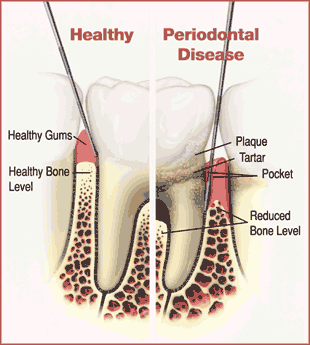
Ouch
is what I will be saying later this fall. In the drawing, I am the guy on the right. So, I get gum/periodontal surgery. Along with that I get stitches in my gums. Lots of them. I could just let it go and put up with dentures later on. Like my dad says, at least then you get a discount on teeth cleaning.
Oh, and another thing, I would encourage your little kids or grand-kids to take up dentistry as a profession. At least the periodontal kind. For two and a half ours of work, the dentist will collect a cool $5000. Minus expenses of course. Those expenses are $2.95 worth of sutures. (He buys the expensive kind).
I guess I will have to put off for a few months the new Lexus I was planning on buying. And the starving kids are gonna' have to wait too.
Wednesday, August 10, 2005
Faith is sin.
Now that should get your attention. That is right out of the Bible. Romans 14:23 in fact. Maybe you should go look it up. I'll wait a second while you get your Bible out.
Ok. So you say I was wrong in my handling of the text. In fact, you're even a little peeved for my misusing scripture. You rightly want to charge me with a very poor reading of the Bible. I want to tell you it happens all the time.
What exactly was the error of my handling of Romans 14:23? Simple. I took a piece of a verse out of its context. Is taking a piece of a verse out of context any worse than taking a whole verse out of context? I don't think it is. Either way, you are killing the word of God.
The most common reason we take things out of context is that we have an agenda or a pet belief we want to advocate. Out of context proof-texting is our strongest ally for that enterprise. Another motivator behind ignoring context is that we want a ouija-board kind of method of handling scripture. We sort of hover over a sound-byte Bible phrase and listen for what the Spirit is saying, frequently paying no attention to what the writer is saying. You may not be guilty of either of these but this is no strawman argument. It is done all the time.
The problem we can have is that the inviolable principle of context is so pedestrian, so mundane, so boring. There is no short cut method to understanding the Bible. There never will come a day when context is not fundamental.
Now that should get your attention. That is right out of the Bible. Romans 14:23 in fact. Maybe you should go look it up. I'll wait a second while you get your Bible out.
Ok. So you say I was wrong in my handling of the text. In fact, you're even a little peeved for my misusing scripture. You rightly want to charge me with a very poor reading of the Bible. I want to tell you it happens all the time.
What exactly was the error of my handling of Romans 14:23? Simple. I took a piece of a verse out of its context. Is taking a piece of a verse out of context any worse than taking a whole verse out of context? I don't think it is. Either way, you are killing the word of God.
The most common reason we take things out of context is that we have an agenda or a pet belief we want to advocate. Out of context proof-texting is our strongest ally for that enterprise. Another motivator behind ignoring context is that we want a ouija-board kind of method of handling scripture. We sort of hover over a sound-byte Bible phrase and listen for what the Spirit is saying, frequently paying no attention to what the writer is saying. You may not be guilty of either of these but this is no strawman argument. It is done all the time.
The problem we can have is that the inviolable principle of context is so pedestrian, so mundane, so boring. There is no short cut method to understanding the Bible. There never will come a day when context is not fundamental.
Tuesday, August 09, 2005
Liar, Lunatic or Lord.
Those were the choices we got from the evidentialist apologists. Look at the evidence and decide for yourselves. They reasoned that nothing about Jesus' life, conduct, morals, etc. could possibly allow for his being a liar or a lunatic. He must be a Lord. They never mentioned some of the other options. Two of which are that he either never existed or that he never actually said or did any of the things that the Bible credits him with saying or doing.
If you believe either of the latter options, you would be at home in the age of the Enlightenment. In the mid-eighteenth century, the reigning intelligentsia glorified their own reasoning powers and concluded that the New Testament gospels were fabrications of one sort or another. It was the miracles they could not stomach. Any person who held the miracles as factual was either stupid or superstitious.
Theologians of the day, since they trafficked in Bible matters, were caught in a bit of a bind. How could they walk in two worlds at once? They needed to maintain their credibility as reasoning folk and at the same time they wanted to sustain their income off of religion. What to do?
Easy. They put forward the idea that the gospel writers were novelists. They maintained that their writings addressed life situations that arose in the Christian communities. As needs arose within Christian groups it became clear to the evangelists that a document that spoke to those needs should be written. For example, the direction to the rich, young ruler to give all of his possessions to the poor and follow Jesus could have been inspired by growing economic inequities within the community. The story we read in Mark, then, was the evangelists attempt to shepherd Christians through those challenges.
Another explanation they put forward was the idea that the evangelists were fledgling theologians in their own right. They spun the gospels out of their own creative imagination. The opening of the Gospel of St. John would be a prime example of that sort of writing.
Unfortunately, this brings us sort of back to where we started. Now we have to decide the same choice regarding the evangelists: Liars, lunatics or apostles of the Lord. You decide.
Those were the choices we got from the evidentialist apologists. Look at the evidence and decide for yourselves. They reasoned that nothing about Jesus' life, conduct, morals, etc. could possibly allow for his being a liar or a lunatic. He must be a Lord. They never mentioned some of the other options. Two of which are that he either never existed or that he never actually said or did any of the things that the Bible credits him with saying or doing.
If you believe either of the latter options, you would be at home in the age of the Enlightenment. In the mid-eighteenth century, the reigning intelligentsia glorified their own reasoning powers and concluded that the New Testament gospels were fabrications of one sort or another. It was the miracles they could not stomach. Any person who held the miracles as factual was either stupid or superstitious.
Theologians of the day, since they trafficked in Bible matters, were caught in a bit of a bind. How could they walk in two worlds at once? They needed to maintain their credibility as reasoning folk and at the same time they wanted to sustain their income off of religion. What to do?
Easy. They put forward the idea that the gospel writers were novelists. They maintained that their writings addressed life situations that arose in the Christian communities. As needs arose within Christian groups it became clear to the evangelists that a document that spoke to those needs should be written. For example, the direction to the rich, young ruler to give all of his possessions to the poor and follow Jesus could have been inspired by growing economic inequities within the community. The story we read in Mark, then, was the evangelists attempt to shepherd Christians through those challenges.
Another explanation they put forward was the idea that the evangelists were fledgling theologians in their own right. They spun the gospels out of their own creative imagination. The opening of the Gospel of St. John would be a prime example of that sort of writing.
Unfortunately, this brings us sort of back to where we started. Now we have to decide the same choice regarding the evangelists: Liars, lunatics or apostles of the Lord. You decide.
Monday, August 08, 2005

Some people buy a house and they get various kinds of freebees that sort of come with it. Like a filing cabinet in the garage or maybe a lawn mover left in the shed. We got the flower you see above. We actually got several of them. This, as you can see, is an unusual flower. This flower is almost the size of a softball. It has spikes on the leafy parts. It also has jelly-bean-like things squeezing their way out of the body of the flower.
Like a lot of things, this flower makes me wonder what its creator is like. Somehow, the idea that whoever it was that created this flower also decided to try on human flesh and dwell among us does not register very well in my brain. It is incomprehensible for me, but at the same time it is it is as true an idea as any I have ever heard.
Another way of saying this is that the incarnation of the creator makes no sense, but then, neither does any thing else. It is the work of the creator to create reality as well as to make sense of it for us. My own trying to make sense of things is faulty and also futile. Fortunately, I don't have to. I am learning to quit trying. I admit my brain is getting tired and my believer muscle is worn out. Maybe I have been using it way too much.
So, enjoy the flower - the cyber flower, that is.
Saturday, August 06, 2005
Missed
a day, I did. Came home from the gym after work and found a gathering of people and a disconnected computer. My reading/music room was under construction still, so I just couldn't get to you, my fans, for an update.
I have a few more thoughts on tithing, but I don't want to sound bitter, cycnical, or just ticked off in general. So I will (just) let it go (,will ya').
I do have some really worthwhile and practical information for you. A long while back, my niece, Ellen, posted a blurb on her blog where she admitted that she was in posession of that most valuable secret: How to open a CD case in 10 seconds (or less). You know the stupid tape they put on the top to prevent in-store highjackers from stealing the disc right out of the case and making off with it. The only problem was that Ellen didn't share the secret, thus fomenting envy in her uncle. I need this info!!!
So when I went to Tower Records today to spend hard earned cash on some tunes, at the checkout counter I asked the guy with the spiked hair and spiked tongue to show me the trick.
He said, "Thure, mithter. Here'th how itth done". And in 5 seconds he had it open, tape ripped off, and put back together.
So when I got home I tried it myself. But, he had done it so quickly, I really didn't get the whole procedure. So I struggled a bit. It probably took me about 3 minutes to get it. The next one I tried, however, only 30 seconds. The last one - 10 seconds. What a scoop I got from my pal at Tower!
Ya wanna' know the secret? All you have to do is open the CD from the bottom - it's not sealed down there- and while you're opening it, you pry the little hinge tab out of its hole. Now, the only thing hinging or holding the whole case together is the annoying tape, which you will find comes apart really easily with the case opened up.
Try it, you'll like it.
a day, I did. Came home from the gym after work and found a gathering of people and a disconnected computer. My reading/music room was under construction still, so I just couldn't get to you, my fans, for an update.
I have a few more thoughts on tithing, but I don't want to sound bitter, cycnical, or just ticked off in general. So I will (just) let it go (,will ya').
I do have some really worthwhile and practical information for you. A long while back, my niece, Ellen, posted a blurb on her blog where she admitted that she was in posession of that most valuable secret: How to open a CD case in 10 seconds (or less). You know the stupid tape they put on the top to prevent in-store highjackers from stealing the disc right out of the case and making off with it. The only problem was that Ellen didn't share the secret, thus fomenting envy in her uncle. I need this info!!!
So when I went to Tower Records today to spend hard earned cash on some tunes, at the checkout counter I asked the guy with the spiked hair and spiked tongue to show me the trick.
He said, "Thure, mithter. Here'th how itth done". And in 5 seconds he had it open, tape ripped off, and put back together.
So when I got home I tried it myself. But, he had done it so quickly, I really didn't get the whole procedure. So I struggled a bit. It probably took me about 3 minutes to get it. The next one I tried, however, only 30 seconds. The last one - 10 seconds. What a scoop I got from my pal at Tower!
Ya wanna' know the secret? All you have to do is open the CD from the bottom - it's not sealed down there- and while you're opening it, you pry the little hinge tab out of its hole. Now, the only thing hinging or holding the whole case together is the annoying tape, which you will find comes apart really easily with the case opened up.
Try it, you'll like it.
Thursday, August 04, 2005

If
you feel so led and if you feel better having read my writings, I will humbly accept your donation. I prefer paypal but money orders work okay also. I am not set up for Visa at this time.
Above is a photo of the boat I intend to buy with the proceeds from this ministry.
Sorry about no artsy-fartsy post today. My scanning salon is under construction so I had to dig up a file that we already had on the hard-drive. Signed prints are available for $325.
Wednesday, August 03, 2005
Lame
is what this blogging software is. I have failed repeatedly to update my profile. I no longer want to go through their updating exercise. Not that it matters much since things like 'my favorite movies' and other such inanities have zero value. So, don't bother looking for it.
My promise has been brevity. So, my thesis is that tithing has been relegated to the dust-bin of history. My intuition: there is zero probability that nascent church would have brought along this one institution from the collapsed Mosaic economy.
The trickiest argument in favor of the practice has always been that, though the law had been superceded, fulfilled, eclipsed (you pick a word here) in Christ, (see Col. 2:13,14) tithing must remain because it was instituted prior to the law.
Proponents of tithing being a church requirement always trot out Abraham's ten percent donated to Mel. (see Genesis 14) as the driving principle. I am a little confused by that passage since we could easily see Mel. giving a tenth to Abraham, not the other way around. Given the standard interpretation, I don't buy it since while that cash was a tithe (a tenth) it was not tithing - as an ongoing practice. In short, we have to ask why we don't see Abraham making a practice of it.
As for the contention that tithing got imported into the church age, a key text is 1 Cor 16:1ff:
Now concerning the collection for the saints: as I directed the churches of Galatia, so you also are to do. On the first day of every week, each of you is to put something aside and store it up, as he may prosper, so that there will be no collecting when I come. And when I arrive, I will send those whom you accredit by letter to carry your gift to Jerusalem.
The church had been functioning for twenty (+- 1) years (the date of 1 Cor is widely given as 55 ad.) without this direction. This passage can only be read as a specific administrative method for facilitating a specific fund raising activity. To extend this passage to indicate an modus operandi for all time in the church has to fail.
This amounts to an effective argument from silence. Only if there is no tithing happening in the church since its beginning would Paul have had to do this adminstrative organization for the purpose of collecting a gift to be brought to Jerusalem.
A lot more could be said. But, I have reached my word limit.
My adoring fans are clamoring for more photographs, so I will make every attempt to please them. Come back tomorrow for something artsy/fartsy.
is what this blogging software is. I have failed repeatedly to update my profile. I no longer want to go through their updating exercise. Not that it matters much since things like 'my favorite movies' and other such inanities have zero value. So, don't bother looking for it.
My promise has been brevity. So, my thesis is that tithing has been relegated to the dust-bin of history. My intuition: there is zero probability that nascent church would have brought along this one institution from the collapsed Mosaic economy.
The trickiest argument in favor of the practice has always been that, though the law had been superceded, fulfilled, eclipsed (you pick a word here) in Christ, (see Col. 2:13,14) tithing must remain because it was instituted prior to the law.
Proponents of tithing being a church requirement always trot out Abraham's ten percent donated to Mel. (see Genesis 14) as the driving principle. I am a little confused by that passage since we could easily see Mel. giving a tenth to Abraham, not the other way around. Given the standard interpretation, I don't buy it since while that cash was a tithe (a tenth) it was not tithing - as an ongoing practice. In short, we have to ask why we don't see Abraham making a practice of it.
As for the contention that tithing got imported into the church age, a key text is 1 Cor 16:1ff:
Now concerning the collection for the saints: as I directed the churches of Galatia, so you also are to do. On the first day of every week, each of you is to put something aside and store it up, as he may prosper, so that there will be no collecting when I come. And when I arrive, I will send those whom you accredit by letter to carry your gift to Jerusalem.
The church had been functioning for twenty (+- 1) years (the date of 1 Cor is widely given as 55 ad.) without this direction. This passage can only be read as a specific administrative method for facilitating a specific fund raising activity. To extend this passage to indicate an modus operandi for all time in the church has to fail.
This amounts to an effective argument from silence. Only if there is no tithing happening in the church since its beginning would Paul have had to do this adminstrative organization for the purpose of collecting a gift to be brought to Jerusalem.
A lot more could be said. But, I have reached my word limit.
My adoring fans are clamoring for more photographs, so I will make every attempt to please them. Come back tomorrow for something artsy/fartsy.
Tuesday, August 02, 2005

Next
time you are in San Francisco, make sure you get over to the City Hall building. There, you will see what may be the most impressive staircase in the country. What's the significance of this entry? None. None at all. But that's what you get today.
I am not ready to launch into anything interesting or controversial. In order to get ready for what's coming, I suggest you read the first few verses of 1 Corinthians 16. I believe that section has implications for a position on tithing.
Monday, August 01, 2005
A workable solution
to the problem that still allows individuals to claim deductions on their income tax returns for charitible giving is the following: A score is given to each institution for which an individual may want to claim a deduction. That score becomes a percentage which is multiplied with the amount donated by the individual. The resulting number is how much of the individual's donation he may deduct. The score is a function of the the percentage of the "take" is actually used to help the needy in a material way. This will tend to lead people to give to the institutions which materially meets the need best. It will incentivize institutions to help the needy more efficiently.
People who donate to a church whose budget of $1,000,000 includes $25,000 actually given to the "poor" will find they can deduct only 2.5% of their donation.
The devil, of course, is in the details (or in Massachusetts) and centers around the definition of "materially" assissting. The goal is to get the US government out of the ideology business, as it is supposed to be already.
Come back tomorrow for something new and, if you're good, maybe a new photo for your viewing pleasure.
to the problem that still allows individuals to claim deductions on their income tax returns for charitible giving is the following: A score is given to each institution for which an individual may want to claim a deduction. That score becomes a percentage which is multiplied with the amount donated by the individual. The resulting number is how much of the individual's donation he may deduct. The score is a function of the the percentage of the "take" is actually used to help the needy in a material way. This will tend to lead people to give to the institutions which materially meets the need best. It will incentivize institutions to help the needy more efficiently.
People who donate to a church whose budget of $1,000,000 includes $25,000 actually given to the "poor" will find they can deduct only 2.5% of their donation.
The devil, of course, is in the details (or in Massachusetts) and centers around the definition of "materially" assissting. The goal is to get the US government out of the ideology business, as it is supposed to be already.
Come back tomorrow for something new and, if you're good, maybe a new photo for your viewing pleasure.
Subscribe to:
Posts (Atom)